
Business Class International Flights: Full Guide

An overnight flight from New York to Tokyo and a two-hour domestic premium seat may share the words “business class,” yet the experience is not remotely the same. That distinction matters because many travelers researching a business class international flight want more than a fare label. They want better sleep, more privacy, smoother airport flow, stronger dining, and a journey that feels easier from departure to arrival. This article focuses on that divide. For readers who want the broader definition first, what is business class provides useful foundation before this more specific comparison.
Why International Business Class Is a Different Category
Domestic premium cabins and international business class serve different traveler needs. On many U.S. domestic routes, airlines center the front cabin on a wider recliner seat, earlier boarding, improved meal service on select sectors, and a more spacious work setting. By contrast, airlines create international business class, especially on long-haul routes between the U.S. and Europe, Asia, the Middle East, or Australia, as a true end-to-end premium travel product.
That usually means lie-flat seating, direct aisle access on leading configurations, upgraded bedding, more substantial inflight dining, lounge access, and a ground experience that reduces friction. Carriers commonly associated with strong international business class products include Qatar Airways, Singapore Airlines, ANA, JAL, Lufthansa, Emirates, British Airways, Delta One, United Polaris, and American Airlines Flagship products. Yet the exact experience varies meaningfully by route, aircraft, and cabin layout.
Flight Experts specializes in premium cabin planning across these long-haul markets, with business class booking support for routes from the U.S. to Europe, Asia, the Middle East, Australia, and domestic U.S. travel as well. The agency uses a consultative process rather than a self-service model. A traveler submits a request, an expert joins the booking at no charge, and options usually arrive within about 30 minutes. Support may also include seat selection, meal preferences, check-in assistance, price drop monitoring, and cabin upgrade alerts. Readers comparing route possibilities may also find the Business Class Flights to Asia and Business Class Flights to Europe sections useful for market context.
What Changes Once a Flight Becomes Long Haul
The most consequential difference is not prestige. It is functionality. Airlines build a true business class international flight cabin around real long-haul needs. Travelers may need to sleep, dine calmly, work in private, change time zones, and arrive ready for a meeting or an important personal trip. A domestic premium seat, even a comfortable one, rarely solves all of those needs at once.
Seat design on a business class international flight
Start with the seat. On long-haul aircraft, business class typically means a fully flat or near-flat bed. It often comes in a 1-2-1 layout that gives each passenger direct aisle access. That matters far more than seat width alone. You can sleep without climbing over another passenger, keep personal items within reach, and enjoy more privacy. As a result, the journey feels less like endurance and more like usable travel time.
By contrast, many domestic premium cabins still use recliner-style seats. Some are attractive and well padded. However, they do not support a true overnight rest cycle in the same way.
Ground services and onboard service
Then there is the ground experience. International business class frequently includes lounge access, dedicated check-in counters, and priority boarding. In some markets, it also offers a more composed premium terminal flow. On select top-tier products, travelers may encounter private check-in spaces or chauffeured transfers, though these remain carrier-specific privileges rather than universal business class features. Domestic premium cabins may include priority treatment, but lounge access is often absent unless tied to a premium transcontinental product, club membership, or elite status. For a deeper look at business class lounge access, readers can compare how entry rules vary by fare and airline.
Dining and service also shift in tone. International business class generally offers multicourse meal service, stronger wine and beverage programs, more substantial amenity kits, and bedding meant for an overnight sector. On better carriers, dine-on-demand or flexible meal timing may be available. Domestic premium cabins can be pleasant, particularly on longer coast-to-coast services, but they usually follow a shorter service window and offer less personal space.
Aircraft type matters as much as the airline name. A modern suite on an Airbus A350 or Boeing 787 may feel dramatically more refined than an older angled or staggered product on another long-haul aircraft. For that reason, many experienced travelers seek professional guidance before purchasing international business class tickets. The fare may say business class in both cases, while the lived experience differs considerably.
There is also a planning misconception worth clearing up. Some readers searching for cheap business class are really trying to understand how to access stronger premium cabins without wasting money on weaker aircraft or inconvenient routings. In practice, the better question is not how to find the lowest headline fare. It is how to identify the right cabin product for the route, timing, and purpose of the trip.
Flight Experts centers its business class booking service on exactly that complexity. Rather than leaving a client to decode alliance options, fare rules, mixed aircraft quality, and seat map differences alone, the agency presents curated options across major carriers and helps align the product to the traveler’s priorities. For more route and product background, the Airline Business & First Class Reviews and Premium Cabin Experience & Amenities sections add broader editorial context.
What Business Class Usually Includes on an International Flight
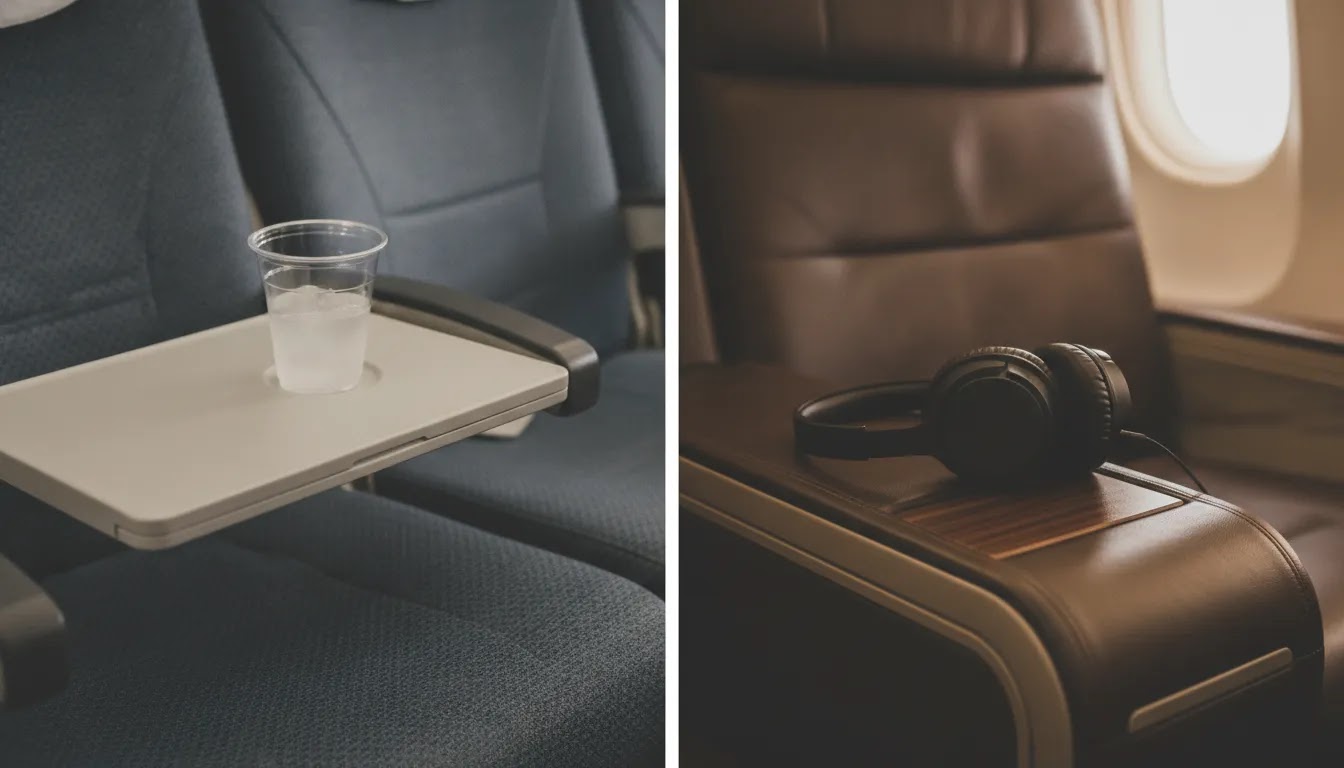
Many travelers asking about a business class international flight want a practical answer to a practical question: what is actually included once the ticket is issued. In most cases, the core elements may include a lie-flat or near-flat seat on the long-haul segment, lounge access before departure, dedicated or priority check-in, earlier boarding, enhanced dining, bedding for overnight service, and an amenity kit with essentials for a long flight. Entertainment screens are typically larger than those found in domestic premium cabins. Wi-Fi may be available for purchase or included on some airlines, though the policy varies widely by carrier and route.
Core features travelers can expect
That said, the cabin label alone does not confirm every feature. Some itineraries include an excellent long-haul seat but rely on partner lounge facilities rather than a flagship lounge. Others may offer bedding only on overnight sectors or limit certain dining elements on shorter daytime flights. Even within the same airline, the onboard product may differ by aircraft generation. Service touches such as mattress pads, pajamas, dine-on-demand, or premium beverage lists may appear on one route and not another.
Why exact itinerary details matter
There is also a meaningful difference between the core business class proposition and higher-touch extras that specific airlines or airports provide. Private check-in areas, escort services, partner lounge arrangements of varying quality, shower suites in premium lounges, or chauffeured ground transfers may be available in select markets. However, travelers should view them as route-specific advantages rather than universal business class entitlements. Sophisticated travelers usually benefit from verifying the booked itinerary in detail instead of assuming that promotional photography or a broad airline reputation reflects every departure city and every aircraft.
The most useful way to assess value is to review what the ticket includes on the exact journey being purchased. If a business class international flight includes a fully flat bed, direct aisle access, a strong lounge arrangement, and a schedule that supports real rest, that may matter far more than an itinerary whose marketing materials sound impressive but deliver a weaker seat or fragmented airport experience. This is where expert review can be especially helpful, because what appears similar at the fare level may feel very different in practice.
| Feature | Often found on a business class international flight | Often found in a domestic premium cabin |
|---|---|---|
| Seat type | Lie-flat or near-flat seat on the long-haul segment | Wider recliner seat |
| Aisle access | Direct aisle access on leading configurations | Not typical |
| Lounge access | Often included before departure | Often absent unless tied to a special product, club membership, or elite status |
| Dining | Enhanced or multicourse meal service | Improved meal service on select sectors |
| Bedding | Often included for overnight service | Usually not part of the core product |
| Trip purpose | Built for sleep, privacy, and long-haul comfort | Built for shorter premium travel and workspace |
Investment and Value
For Flight Experts clients booking business class, published pricing typically falls in a broad range of about $2,000 to $8,000+, depending on route, season, airline, and cabin product. That range reflects just how different international business class can be from one market to another. A transatlantic daytime flight may price very differently from a peak-season transpacific overnight sector or a premium Middle East connection with a highly regarded suite-style product.
Value in this category is not measured only by fare level. It is measured by what the ticket enables. On a genuine long-haul itinerary, that may include meaningful sleep, reduced airport friction, better schedule tolerance, and a calmer arrival. Those gains matter to executives flying directly into meetings, couples beginning a milestone trip, and families trying to reduce stress on complex international journeys.
Flight Experts states that its business class booking service may access consolidator pricing and personalized option sets, with support that includes seat selection, meal preference handling, check-in assistance, and alerts tied to price movement or cabin upgrade opportunities. Options usually return within about 30 minutes after a request is submitted. That speed can be especially helpful when a traveler is balancing multiple departure cities, alliance choices, or connection structures. The agency also maintains a 5.0 Trustpilot rating based on 79 reviews at the time reflected in the available service data.
For itineraries that go beyond a single round trip, Business Class Flight Booking may be paired with more tailored planning logic, especially when the traveler needs open-jaw routing, stopovers, or mixed-carrier long-haul segments. Travelers comparing cabin value more broadly may also find Business Class vs Economy: Is It Worth the Upgrade? useful for context.
How to Evaluate an International Business Class Product Before Booking
Once value is framed correctly, the next step is verification. A sophisticated traveler should review the aircraft type, seat configuration, and whether every passenger has direct aisle access on the long-haul sector. An overnight crossing to Europe or Asia places a premium on sleep quality, privacy, and bed length. By contrast, a daytime flight may place greater emphasis on workspace, dining cadence, and lounge quality before departure. The same fare category can serve these two use cases very differently.
Check the aircraft and seat first
Connection structure also deserves close attention. One itinerary may feature an excellent flagship cabin on the main long-haul segment, then pair it with weaker regional legs that offer little privacy, limited storage, or no meaningful lounge experience during transit. Mixed-cabin or mixed-product journeys are common enough that travelers should assess them deliberately, especially if they assume the strongest segment represents the entire trip.
A short feeder flight in a narrow-body recliner seat may be perfectly acceptable in some cases. However, it can materially change the overall experience if the transfer is lengthy or the itinerary begins with an early departure and a weak airport setup.
Confirm lounges and connecting segments
Lounge arrangements should also be confirmed rather than assumed. Some airlines operate excellent branded lounges with refined dining, showers, quiet work areas, and more polished service standards. Others rely on alliance or contract lounges that are functional but less impressive. For travelers departing on overnight sectors, this difference can affect how well the journey starts. For arrivals involving immediate business commitments or celebrations, the route’s total airport experience may matter nearly as much as the seat itself.
This is one of the clearest reasons expert review remains useful, even for experienced premium travelers. Similar fares may conceal meaningful differences in sleep quality, privacy, airport flow, and consistency across segments. A professional advisor who regularly evaluates premium cabins can identify those differences quickly and match them to the purpose of the trip, rather than treating every international business class ticket as interchangeable.
Strengths and Considerations

Strengths
- International business class usually delivers a fundamentally different sleep proposition than domestic premium cabins, especially on lie-flat overnight routes.
- Ground services tend to be more complete, often including lounge access, premium check-in, and priority airport handling that may materially reduce stress.
- Cabin design is typically built for long-duration comfort, with better privacy, more storage, stronger bedding, and a calmer service cadence.
- Route-specific product choice matters, and expert guidance can help travelers avoid paying business class fares for outdated or less suitable configurations.
- Flight Experts supports the process with human consultation, usually quick turnaround, and assistance that extends beyond ticketing into seat, meal, and check-in details.
Considerations
- Not every international business class product is exceptional. Older aircraft, denser layouts, or regional feeder segments may dilute the experience.
- Domestic premium cabins on select premium transcontinental routes can narrow the gap in certain respects, so the label alone should not drive the decision.
- Pricing varies significantly by season, airline, route, and availability, and the strongest products may command a substantial premium.
- Lounge access, chauffeur transfers, and private ground features are not universal. These benefits depend on the carrier, airport, fare rules, and alliance arrangements.
Airport and Arrival Advantages Beyond the Seat
The seat tends to receive the most attention, but much of the practical value of a business class international flight may be felt before takeoff and immediately after landing. In stronger airport environments, travelers may benefit from quieter lounge settings, more composed preflight dining, shower facilities, premium rest areas, and more efficient ground handling from check-in through boarding. None of these elements is universal, and their quality can differ sharply by hub. Still, on the right route they can change the tone of the journey well before boarding begins.
Those airport advantages often carry into the arrival experience. A traveler who has eaten properly before departure, rested in a calmer lounge, boarded without crowding, and slept for several hours in a true bed may arrive better prepared for a board meeting, a private transfer, an anniversary dinner, or a same-day connection to a resort or villa. Premium travel is rarely about a single onboard moment. Instead, it is about preserving energy, composure, and momentum across the full itinerary.
Arrival handling also varies. Some airports and airlines deliver a particularly polished premium flow, while others provide only the essential elements attached to the ticket. Lounge access on connection, fast-track processing where available, baggage priority, and the proximity or quality of transfer facilities may all affect how effortless the trip feels in reality. Because of those differences, route-specific verification remains important. An experienced advisor can confirm whether a given itinerary offers a genuinely elevated ground experience or simply a strong seat with less distinctive airport support.
Who This Experience Is For
This level of travel suits readers who see the flight as part of the outcome, not merely transportation. That includes frequent long-haul business travelers who need to arrive rested, couples marking honeymoons or anniversaries, families managing demanding international itineraries, and travelers who place a premium on privacy, predictability, and time efficiency. It is especially relevant for anyone comparing a business class international flight fare against a domestic-style front cabin and wondering why the difference can be so pronounced in both comfort and service design.
How to Begin Planning With a Specialist

The best starting point is clarity about the journey rather than fixation on a cabin label. Share your preferred dates, origin city, destination, flexibility, and the quality markers that matter most to you, such as direct aisle access, sleep quality, lounge access, or minimal connection time. From there, Flight Experts can evaluate suitable carriers and routings across major business class international flight markets.
The agency’s business class process is straightforward: submit a request through the website, receive an assigned expert at no charge, review tailored options that are usually presented within about 30 minutes, then choose the itinerary that best fits your priorities. Support may continue through seat selection, meal preferences, check-in assistance, price drop monitoring, and upgrade alerts.
For travelers whose journey is more intricate than a single round trip, the agency also offers Complex Itinerary Planning for multi-city, open-jaw, and alliance-based routing. If you are deciding between cabins before booking, Premium Economy vs Business Class: Key Differences can help frame the tradeoffs. If you prefer a concierge relationship rather than a self-directed search, speak with a luxury travel specialist at Flight Experts or contact Mike to discuss your travel preferences and receive a personalized recommendation.
Frequently Asked Questions
Is an international business class flight always lie-flat?
No. Many long-haul business class products are lie-flat, but not all of them. Some shorter international sectors, regional connections, or older aircraft may still offer angled seats or recliner-style seating. Aircraft type and route matter as much as the fare label, which is why verifying the exact cabin product before booking is essential.
How is international business class different from domestic first class?
Domestic first class in the U.S. is often a premium recliner product with enhanced service, while international business class is usually designed for longer sectors with sleep, privacy, and lounge access in mind. The international version tends to include flatter beds, more structured ground services, and a broader overall premium experience.
What should I wear in business class on an international flight?
There is rarely a formal dress code, but polished and comfortable attire is the most practical choice. On overnight routes, many travelers prefer soft layers, loafers or refined sneakers, and clothing that allows easy movement and rest. For more guidance, see What to Wear on a Business Class Flight.
Are international business class tickets worth it for daytime flights?
They may be, depending on your priorities. Even on daytime sectors, travelers can benefit from more personal space, better dining, lounge access, quieter cabins, and a more efficient airport experience. The value becomes especially clear for those working during the flight, protecting energy for a same-day arrival, or beginning an important trip in a calmer frame of mind.
Does lounge access come with every international business class fare?
It often does, but not universally in the same way. Access policies may vary by airline, airport, partner lounge arrangement, and fare rules. Some carriers operate outstanding flagship lounges, while others rely on contract facilities in certain cities. A travel specialist can confirm what is actually included on the specific itinerary you are considering.
Can a travel advisor help compare business class products across airlines?
Yes, and this is often where professional support is most valuable. Two airlines may offer similar schedules and fares while providing very different seat layouts, privacy levels, bedding, lounge quality, and service consistency. A specialist can compare the practical experience, not just the headline fare and departure time.
How quickly can Flight Experts return options for business class flights international?
According to current service information, options are usually presented within about 30 minutes after a request is submitted and an expert is assigned. Timing may vary with itinerary complexity, especially for multi-city or mixed-carrier requests, but the process is designed to be personal, efficient, and consultative rather than automated.
What does business class get you on an international flight?
In most cases, it may include a lie-flat or near-flat seat on the main long-haul segment, lounge access, priority check-in and boarding, elevated dining, bedding on overnight routes, and a more private cabin environment. The exact inclusions depend on the airline, aircraft, airport, and fare rules, so the most accurate answer comes from reviewing the specific itinerary rather than relying on the cabin name alone.
Do airlines clean seats between flights?
They typically do, but the depth of cleaning may vary by airline, station, turnaround time, and operational conditions. Most carriers perform routine cabin cleaning between flights, while more detailed servicing may take place overnight or during longer ground periods. Travelers who prioritize a particular standard of onboard presentation may wish to focus on airlines known for stronger premium cabin consistency and confirm current expectations where possible.
Why do flight attendants sit on their hands when flying?
During takeoff and landing, cabin crew may place their hands in a braced position, sometimes seated on them or keeping them secured against their thighs, as part of safety procedure. The purpose is to stabilize posture and reduce movement in the event of sudden impact or turbulence during critical phases of flight. The exact brace position may vary by airline and aircraft type, because crew procedures are set by each carrier’s safety protocols and regulatory framework.
Key Takeaways
- International business class is usually a different product category from domestic premium cabins, especially on overnight long-haul routes.
- The biggest differences are typically lie-flat sleep, lounge access, privacy, and a more complete ground-to-air experience.
- Aircraft and route matter as much as airline branding, because business class quality varies substantially by configuration.
- Flight Experts supports premium travelers with personalized business class booking, usually fast response times, and post-booking service details that self-service platforms often leave to the traveler.
- The right comparison is not simply fare versus fare, but experience quality versus trip purpose.
Conclusion
The phrase business class covers a wide spectrum, but a business class international flight generally earns separate consideration because it is built for a different job. It aims not only to move a traveler across borders, but also to preserve rest, privacy, and composure over many hours in the air. That is why a domestic front cabin comparison can be misleading, even when the labels sound similar.
If your next journey involves a long-haul route and you want clarity on which cabins genuinely justify the investment, Flight Experts offers a more precise way to plan. Mike Chirilenco and the team focus on matching travelers to the right premium product, not simply any available business class seat. Reach out to discuss your travel preferences and begin shaping an itinerary with specialist guidance.
For general airline consumer information, readers may also consult the U.S. Department of Transportation Office of Aviation Consumer Protection and the International Air Transport Association passenger guidance.



