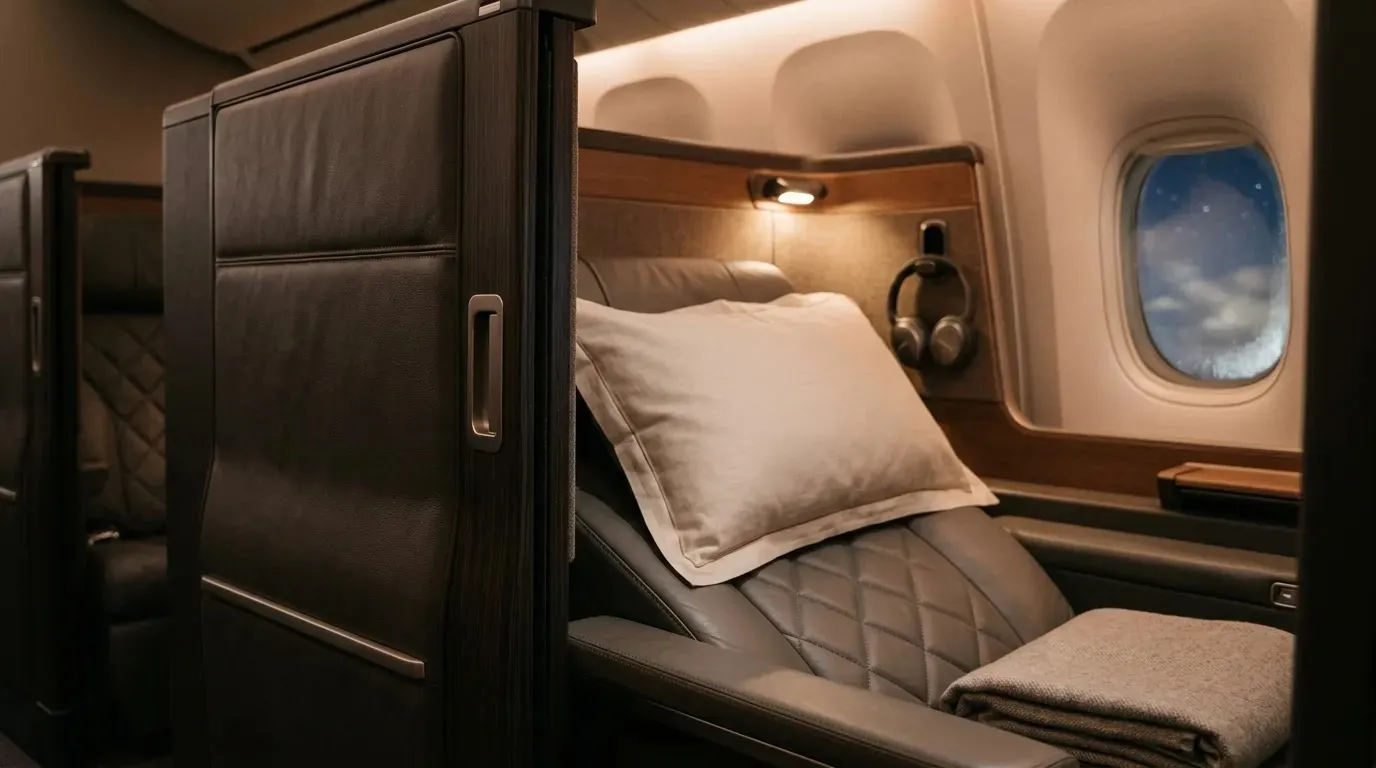
First Class Airfare Deals: How to Save on Luxury Travel

The 3 things that matter most when buying first class airfare deals:
- Confirm the operating aircraft: The seat, dining, lounge access, and privacy can vary materially by route and aircraft type.
- Read the fare conditions before payment: A promotion has limited value if changes, cancellations, or route adjustments create unnecessary exposure.
- Judge the complete itinerary, not the headline fare: Connection quality, ground services, and the longest flight sector determine the real value.
First Class airfare deals: a focused buying brief
First class airfare deals tend to emerge through a small number of recurring patterns: published seasonal promotions, route-specific inventory releases, companion-oriented offers, and occasional filing or distribution errors. Each pattern calls for a different response. A seasonal offer may allow time for a considered comparison. An apparent error fare may require quick verification and a willingness to accept uncertainty.
This article concentrates on how to recognize those patterns without allowing urgency to override quality. For broader context on locating First Class fare opportunities, review the related Flight Experts resource before deciding whether a particular promotion suits your itinerary.
The objective is not to buy a ticket merely because the fare moved. It is to identify a well-constructed First Class journey that remains appropriate after you assess cabin consistency, airport experience, flexibility, and the importance of the trip itself.
Who should pursue First Class airfare deals
First class airfare deals can suit travelers who already know the value of a flagship cabin. They also suit those with enough flexibility in dates, gateways, or routing to respond to a worthwhile offer. They are especially relevant for couples planning a celebratory trip, executives traveling on demanding long-haul schedules, and families coordinating travel around a fixed occasion but with some latitude on departure days.
They may also work well where the fare applies to a route that already matches your plans. A traveler flying from a preferred departure city to a destination where the carrier operates its strongest First Class product has a far better starting point than someone reshaping an entire journey around a single temporary fare.
Who should not make a promotion the central booking strategy
A fare-led approach is less suitable if your dates are immovable, you must attend a wedding or cruise embarkation, or you need a very specific flight time. It is also less appropriate for itineraries with fragile connections, important onward arrangements, or multiple travelers whose preferences are difficult to align.
For those trips, the quality of the finished itinerary usually matters more than waiting for a public promotion. First Class should remove friction. A complicated routing or unfavorable change condition can undermine that purpose before you arrive at the airport.
The promotion calendar behind First Class fares
Airlines do not release premium offers according to a universal calendar. Still, certain periods repeatedly bring more visible activity. Demand often softens outside major holiday peaks, and carriers may use limited promotions to stimulate premium bookings in selected markets. Travelers whose destinations are not tied to a school holiday or major event can find productive shoulder periods around spring and fall.
Seasonality alone is not enough. First Class inventory is narrow, and carrier decisions may reflect local demand, competitive routing, currency conditions, aircraft deployment, or the need to fill a specific flight rather than an entire season.
Published seasonal campaigns
These are the most straightforward first class flight deals to assess. They usually have booking deadlines, defined travel windows, and published fare rules. Their relative transparency makes them attractive for travelers who need time to compare departure cities, verify seat maps, and coordinate hotels or private transfers.
A public campaign still deserves close reading. Some offers apply only to particular fare classes. Others require a Saturday-night stay, exclude peak dates, or price differently depending on the departure point. The highest-quality cabin may also be unavailable on the lowest promotional fare dates.
Route and gateway patterns
First Class fare activity often concentrates in markets with more than one viable departure gateway. A traveler based near several major airports may find that a short positioning flight or car transfer opens more elegant options. However, weigh the added movement against the convenience you lose.
Route structure matters as much as the departure point. A deal that pairs a long First Class sector with a short domestic connection in a lower cabin may still be very attractive. A deal that leaves the longest overnight sector in Business Class may be less compelling, depending on the traveler and the fare difference.
Inventory releases close to departure
Some premium inventory appears later in the booking cycle once an airline has a clearer view of demand. This can benefit travelers with adaptable schedules, but it is not a dependable strategy for a once-in-a-decade holiday. Hotel suites, private guides, villa availability, and preferred dining reservations may be less flexible than the air component.
For a time-sensitive journey, reserve the air travel around the itinerary you need. For a discretionary escape, late inventory can occasionally create an appealing opening if you can travel with limited notice.
Companion and paired-traveler promotions
Some premium campaigns reward two people traveling together. They can be relevant for anniversaries and honeymoons, provided both travelers can accept the same dates, departure point, and fare conditions. Confirm whether both tickets earn the same benefits. Also confirm whether both passengers must make changes together.
The attraction of a paired offer should never eclipse the quality of the actual flights. Two travelers on an inconvenient overnight connection may receive less practical value than two travelers on a more polished, direct itinerary with stronger ground arrangements.
First Class airfare deals: evaluation criteria

Cabin identity on every long-haul sector
First Class is not a uniform product. Some cabins offer enclosed suites, attentive dining, and extensive ground handling. Others provide a refined but more open environment. Before booking first class travel deals, identify the operating airline, aircraft type, seat configuration, and scheduled cabin for each meaningful sector.
A marketing carrier may sell the itinerary, while another airline operates one or more flights. That distinction can affect lounge entry, baggage handling, seat selection, catering, and the cabin itself. Avoid assuming that a First Class label applies equally across every flight.
The value of the longest sector
The longest flight is usually where First Class makes its clearest difference. A private suite, sleep-focused service, and quieter cabin environment have more impact over ten or fourteen hours than on a short regional flight. Review whether the promotion places the flagship product on the sector where you will use it most.
A connecting itinerary can be excellent if the connection is sensible and the long-haul segment is strong. Avoid buying a discounted-looking itinerary that concentrates its premium experience on a brief leg. The overnight sector may offer a materially lesser cabin.
Nonstop flights, one-stop itineraries, and total journey time
A nonstop flight often remains the most graceful choice for an overnight journey, a time-sensitive arrival, or travel that begins immediately upon landing. It reduces operational handoffs, preserves rest, and can make a substantial difference before an important meeting, celebration, or onward private arrangement.
A one-stop First Class itinerary may still be preferable if it provides a markedly stronger cabin on the longest sector, a well-timed departure, or a connection through a premium hub with an exceptional lounge and reliable transfer process. The connection should have a purpose beyond creating a First Class label on the itinerary.
Assess the total journey rather than the scheduled flying time alone. Connection length, terminal layout, immigration procedures, baggage arrangements, protected ticketing, lounge quality, and arrival time at the final destination all affect whether the routing feels considered.
A connection that allows time for a meal, shower, or rest in a strong First Class lounge may be enjoyable. A lengthy layover in an inconvenient terminal, or a tight transfer vulnerable to a minor delay, can weaken an otherwise polished itinerary.
Protected flights issued on one ticket generally provide more support if a delay affects the connection, though rebooking options remain subject to airline operations and available inventory. For complex journeys, Flight Experts can assess whether a connection is a worthwhile part of the experience or an unnecessary point of exposure.
Connection quality and airport experience
Consider what a First Class passenger may enjoy: an expedited security channel, a private lounge before departure, chauffeured arrival in select cities, and dedicated staff upon landing. Naturally, the exact privileges depend on the airline, the specific airport, your fare class, and the particular flight you’ve booked.
Even so, weigh an extended layover against your own stamina and the itinerary that awaits you afterward. Look for realistic transfer times, terminal compatibility, and a clear plan if a delay affects the itinerary. Travelers connecting through unfamiliar airports should avoid margins so tight that they turn a polished journey into an anxious one.
Fare rules and itinerary flexibility
The best first class airfare deals state their conditions clearly. Check whether changes are permitted, whether fare differences apply after a change, how refunds are treated, and whether no-show rules could void later segments. These details matter most when a trip includes event tickets, private accommodations, or important meetings.
Restrictive conditions are not automatically unsuitable. They may be reasonable for travelers with settled plans. The problem arises when a restrictive fare is purchased for a trip whose dates, routing, or guest arrangements are still uncertain.
Seat selection and product confirmation
Secure your preferred suite or seat as soon as the airline makes selection available. Not every airline releases every First Class seat in advance. Airlines may also reassign seats because of aircraft substitutions, operational requirements, or cabin configuration changes.
Confirm the cabin again before departure, particularly on routes known to use multiple aircraft types. A specialist can help interpret the scheduled product, but no advisor controls last-minute operational changes made by an airline.
Ground arrangements and the wider trip
A premium air fare should support the rest of your journey. An early arrival may be ideal if your hotel can confirm early access to your suite, while a late arrival could make a private transfer more important. Coordinate airport arrangements, hotel check-in, dining, and onward travel before treating a promotion as fully booked.
At Flight Experts, every premium booking is considered within the context of the full journey, never as a standalone purchase. When travelers weigh their options against today’s fares, this broader view allows a dedicated specialist to assess whether the chosen flight truly delivers the comfort, consistency, and care befitting a journey of real significance.
First Class availability, airlines, and route reality
True international First Class is available on a limited selection of airlines, aircraft, and long-haul routes. Search results may display a First Class label even where the meaningful premium segment is short, the product is not the carrier’s leading suite, or the longest flight is operated in another cabin. The label is only the beginning of the review.
Assess the airline through the scheduled aircraft, suite design, service consistency, lounge network, and quality of the longest sector. A carrier may be renowned for a particular flagship cabin, yet that cabin may operate only on selected aircraft or between particular gateways. Aircraft assignments can also change, which is why product confirmation remains important after ticketing.
There is a practical difference between choosing an itinerary built around a respected First Class experience and selecting a routing that happens to include a brief First Class segment. A short flight in a premium cabin can improve the airport experience and beginning of the journey, but it does not carry the same value as an overnight sector with a private suite, thoughtful dining, and sufficient time to rest.
For travelers with a specific airline or suite in mind, route planning should begin with the product and aircraft that are scheduled to operate, then work outward to dates and destination arrangements. For others, the strongest choice may be the airline and routing that provides the most consistent experience from departure through arrival, even if it is not the most visibly promoted option.
First Class airfare deals and pricing tiers

There is no reliable single price for First Class because route length, cabin scarcity, departure city, season, flexibility, and airline product all influence the fare. Rather than treating a number as a promise, assess the type of offer and the conditions attached to it. The tiers below describe common market positioning, not fixed pricing.
| Fare type | Typical positioning stated in this guide | Key consideration |
|---|---|---|
| Promotional entry fares | Selected routes, outside the most in-demand travel dates, or with more limiting conditions | Confirm the operating product, connection times, and change terms |
| Flexible premium fares | More freedom to adjust dates or flights | Fare differences and policy details may still apply |
| Flagship cabin and peak-date fares | Scarce suites on heavily requested dates, desirable nonstop routes, or a carrier’s most elaborate First Class offering | Compare aircraft, suite layout, connection, and airport services |
Promotional entry fares
These fares usually appear on selected routes, outside the most in-demand travel dates, or with more limiting conditions. They may be appropriate for a flexible leisure trip where the cabin and routing remain excellent. Look for a clear confirmation of the operating product, adequate connection times, and change terms that fit your plans.
Avoid assuming that an entry-level First Class fare represents a flagship suite or the full range of ground privileges at every airport. The ticket can still be highly enjoyable, but the experience should be assessed precisely.
Flexible premium fares
Flexible fares typically offer more freedom to adjust dates or flights, though fare differences and policy details may still apply. They can make sense for business travel, family events, or milestone trips where a schedule shift would be disruptive. The higher outlay may provide meaningful reassurance if the itinerary is still developing.
Verify the exact flexibility rather than relying on a broad label. Airline terminology differs, and some benefits apply only before departure or only to the original routing.
Flagship cabin and peak-date fares
At the highest end, fares may reflect scarce suites on heavily requested dates, desirable nonstop routes, or a carrier’s most elaborate First Class offering. These bookings often suit travelers who prioritize a particular product, flight schedule, or destination season over promotional timing.
High pricing does not automatically mean the itinerary is better. Compare the scheduled aircraft, suite layout, connection, and airport services. A quieter route with a superior cabin and more graceful timing may offer a better overall experience than a high-demand flight selected purely for prestige.
When First Class delivers meaningful value over Business Class
First Class is not automatically the right answer for every itinerary. Its greatest value typically appears on long overnight flights, milestone journeys, and schedules where arriving rested and composed has real importance. On those sectors, additional privacy, a more attentive service rhythm, flexible dining, and enhanced ground handling may materially improve the experience.
The distinction is often most visible in the details. A First Class suite may offer more personal space and fewer cabin disturbances. Dining may be arranged around your preferred time rather than a fixed service sequence. At selected airports, dedicated check-in, refined lounges, arrival assistance, or private transfer arrangements may further reduce friction. The precise offering depends on the airline, route, fare, and operating aircraft.
Business Class can be the stronger choice where it provides an excellent lie-flat seat on a preferable nonstop flight, particularly if the First Class alternative requires a difficult connection or arrives at an inconvenient hour. A well-designed Business Class cabin on the right schedule may support rest and productivity better than a First Class itinerary built around a compromised routing.
The purpose of the journey should guide the decision. For a honeymoon departure, anniversary, or demanding transcontinental business commitment, First Class may justify its place through privacy and continuity. For a shorter daytime sector, or a route where Business Class offers a highly regarded product and superior timing, the experiential difference may be less meaningful. A qualified advisor can compare the actual cabins and route options available for your travel dates rather than treating either cabin as universally preferable.
Error fares and short-lived opportunities
An error fare may result from a currency conversion issue, tax display problem, fare filing mistake, or a technical disconnect between airline systems and distribution channels. It can look dramatically different from normal published pricing, but it carries a distinct level of uncertainty. Airlines may honor, correct, or cancel an error fare depending on the circumstances and applicable rules.
If you encounter an apparent error fare, avoid making nonrefundable hotel, villa, cruise, or event commitments until the ticket has been issued and you have allowed reasonable time for the airline to review it. Even after ticketing, airline schedule changes and fare reviews remain possible.
How to distinguish a plausible promotion from a possible mistake
A plausible promotion often appears across several dates, is supported by published terms, and aligns with a known seasonal campaign or route pattern. A suspected error may be isolated to one date, one point of sale, or one unusual currency display. Neither category can be judged by price alone.
Verify the itinerary details, fare class, taxes, ticketing status, and operating carrier before making decisions around it. For a complex First Class journey, a luxury travel specialist may provide valuable context on whether the opportunity is usable or merely visually striking.
Why patience after ticketing is prudent
Ticket issuance is an important milestone, but it is not a reason to accelerate every other part of a trip. Give the booking time to settle, keep records of the fare conditions, and monitor airline communications. If the itinerary is for a fixed occasion, retain a practical alternative until you are comfortable with its status.
That restraint is especially useful for travelers arranging multiple rooms, private aviation connections, or destination services. The more components a journey contains, the more valuable it is to protect them from the uncertainty of a short-lived fare anomaly.
Booking errors that can weaken a premium trip

- Booking immediately without checking which airline operates each sector and what aircraft is scheduled.
- Assuming lounge access, chauffeur service, or arrival privileges apply in every airport and on every marketed itinerary.
- Choosing a long or awkward connection solely because the total fare appears attractive.
- Purchasing restrictive tickets before event dates, hotel plans, or companion travel are confirmed.
- Making nonrefundable destination commitments around a suspected error fare before the airline has had time to validate the booking.
- Allowing a promotional deadline to outweigh the importance of travel dates, sleep quality, and cabin consistency.
The strongest first class flight deals are usually the ones that remain attractive after this review. A refined ticket should make the journey easier, not create a chain of compromises that demands constant monitoring.
Buying checklist before ticketing
Before you commit to first class airfare deals, confirm the following points in writing or within the airline record:
- The operating airline and scheduled aircraft for every long-haul flight.
- The cabin type and seat configuration on the sectors that matter most.
- Connection times, terminal changes, and lounge arrangements at each stop.
- Fare rules for changes, cancellations, missed flights, and voluntary rerouting.
- Whether advance seat selection is available and whether your preferred seat can be requested.
- The timing of hotel check-in, transfers, and any onward private arrangements.
- Passport validity, visas, transit permissions, and entry conditions for every country on the itinerary.
- Whether the fare is a published promotion, a targeted offer, or a possible error requiring additional caution.
For routes into Europe, the First Class Flights to Europe section may help you frame destination and routing considerations. Travelers planning an Asian itinerary may also wish to review First Class Flights to Asia while comparing likely flight patterns.
Frequently Asked Questions
How often do First Class airfare deals appear?
First Class airfare deals may appear at different times throughout the year, but their frequency depends on route demand, season, departure market, and available premium inventory. Public seasonal campaigns can provide the clearest opportunities, while route-specific adjustments may surface with little notice. Rather than waiting for a universal sale period, define the destinations, date range, and airport options that genuinely suit you. That makes it easier to recognize an offer that is relevant, rather than being distracted by a fare that requires an inferior itinerary.
What airline is best to fly First Class?
The best airline depends on the route, scheduled aircraft, cabin design, airport experience, and purpose of your journey. A carrier known for an exceptional flagship suite may not operate that product on every route, while another airline may provide a more suitable departure time, nonstop service, or stronger connection through its home airport. Review the actual operating flight rather than choosing solely by reputation. For overnight travel, privacy and sleep quality may carry the most weight. For a daytime itinerary, dining, service style, lounge access, and arrival timing may matter more.
Is it really worth it to fly First Class?
Consider a traveler embarking on an overnight transatlantic crossing, marking a significant anniversary, or facing back-to-back client meetings upon arrival. These are the moments when First Class earns its place. The distinction lies not in the label itself, but in tangible enhancements: a private suite for genuine privacy, dedicated attention from cabin crew, dining served at one’s own pace, seamless arrangements on the ground, and an atmosphere conducive to real rest.
On a short hop, or when a superior Business Class cabin offers a more convenient nonstop schedule, the premium may simply not deliver proportionate returns. Ultimately, weigh the choice against the full arc of the journey and what that particular flight is meant to accomplish, rather than deciding by cabin name alone.
Are error fares safe to book?
An error fare can be booked, but it should be approached with care because it may be corrected or canceled by the airline. The prudent response is to verify that the ticket has issued, retain booking documentation, and avoid nonrefundable destination commitments until the booking has had time to settle. Error fares are most suitable for travelers who can tolerate uncertainty and have flexible plans. They are generally less appropriate for a fixed wedding date, a cruise departure, or a milestone journey involving substantial non-air arrangements.
Will every First Class ticket include a private suite?
No. First Class cabins differ substantially between airlines, aircraft, and routes. Some provide fully enclosed suites, while others use open suites or spacious seats with refined service. Even within one airline, a flagship aircraft may offer a different cabin from another aircraft scheduled on the same route family. Check the operating aircraft and seating map before you purchase. If privacy is essential for rest, work, or a special occasion, make the cabin configuration a nonnegotiable part of your selection criteria.
Can a lower First Class fare have restrictive change conditions?
Yes. A promotional First Class fare may have more limited conditions than a flexible published fare. Rules can address cancellation eligibility, change fees, fare differences, minimum or maximum stays, and what happens if you miss a flight. Restrictive conditions are not inherently unfavorable if your itinerary is firm. They become problematic when you have uncertain meeting dates, unconfirmed hotel arrangements, or an event schedule that could shift. Read the conditions before payment, not after a change becomes necessary.
Should I change airports for a better First Class offer?
A different departure airport can be worthwhile if it meaningfully improves the cabin, routing, timing, or fare conditions. It is less appealing if it adds an overnight positioning flight, a difficult ground transfer, or an unprotected connection that creates avoidable risk. Assess the entire door-to-door journey, including airport access, baggage handling, lounge time, and the effect on your arrival day. A slightly higher fare from your preferred airport may provide greater practical value if it preserves ease and continuity.
Do First Class promotions include premium airport services?
Picture arriving at a bustling international hub and being whisked past the queues into a private terminal, only to discover that same privilege doesn’t extend to your connecting flight elsewhere. This is the reality of First Class travel: while enhanced airport services are frequently bundled into the fare, the precise entitlements shift according to the airline, the airport of departure, the operating carrier, and even the specific fare class purchased.
Lounge access tends to be a near-universal inclusion, yet which lounge you’re granted entry to can differ considerably. Expedited check-in and priority boarding are similarly standard. However, more elevated perks such as chauffeur-driven transfers, dedicated terminal access, on-arrival assistance, and access to partner lounges are often reserved for select routes or particular carriers alone. Rather than assuming a benefit promoted in one region will follow you throughout your journey, we recommend verifying the exact privileges attached to every airport on your itinerary.
How far ahead should I book a First Class promotion?
The right booking window depends on your flexibility and the importance of the journey. For a highly specific date, preferred suite, or peak-season destination, earlier planning can preserve more choice. For a discretionary trip, monitoring seasonal activity and later inventory releases may reveal additional possibilities. The appropriate decision point is not simply the earliest or latest available date. It is the moment when the fare, flight schedule, cabin, and fare rules align with the trip you actually want to take.
Can a travel advisor help with airline promotions?
A travel advisor can help place a promotion in context by reviewing the operating aircraft, fare rules, route construction, connection quality, and fit with the broader itinerary. That is particularly useful when an offer has a short booking window or includes multiple carriers. Flight Experts can provide a considered perspective for travelers who want to assess First Class options alongside their preferred schedule and destination arrangements. Availability and airline terms remain subject to change, but informed review can reduce avoidable surprises.
What should I do after booking a First Class fare?
After ticketing, confirm the airline record, request seats where possible, review passport and visa requirements, and coordinate airport transfers with your hotel or destination arrangements. Recheck aircraft and flight times closer to departure because operational changes can occur. If the itinerary includes a connection, understand the terminal process and leave suitable time to enjoy the lounge rather than rushing through it. Travelers should verify current entry, transit, and health requirements directly with official government travel guidance or embassy sources.
Key Takeaways
- First Class fare promotions are most valuable when the scheduled aircraft and longest sector deliver the cabin experience you expect.
- Seasonal campaigns, gateway variations, and inventory releases can create opportunities, but each should be assessed against your real travel requirements.
- Error fares require restraint, ticket verification, and flexibility before you commit to nonrefundable destination arrangements.
- Fare conditions, connection quality, and ground services can matter as much as the published figure.
- Expert review can help turn a short-lived First Class offer into a coherent, high-quality itinerary.
Conclusion
The most attractive first class airfare deals do more than create a favorable moment to book. They place the right cabin on the right route, preserve enough flexibility for the trip ahead, and support the experience you have planned from departure through arrival. Seasonal promotions can reward patience, while unusual fare activity may call for decisive verification. In both cases, a polished decision begins with details rather than excitement alone.
If you are considering a First Class itinerary for a major holiday, business commitment, or personal milestone, speak with the Flight Experts team about your travel preferences. A personalized discussion can help you evaluate current flight options in the context of aircraft schedules, connection quality, and the wider journey, so that the ticket serves the trip rather than dictating it.