
Premium Economy vs Business Class: Key Differences
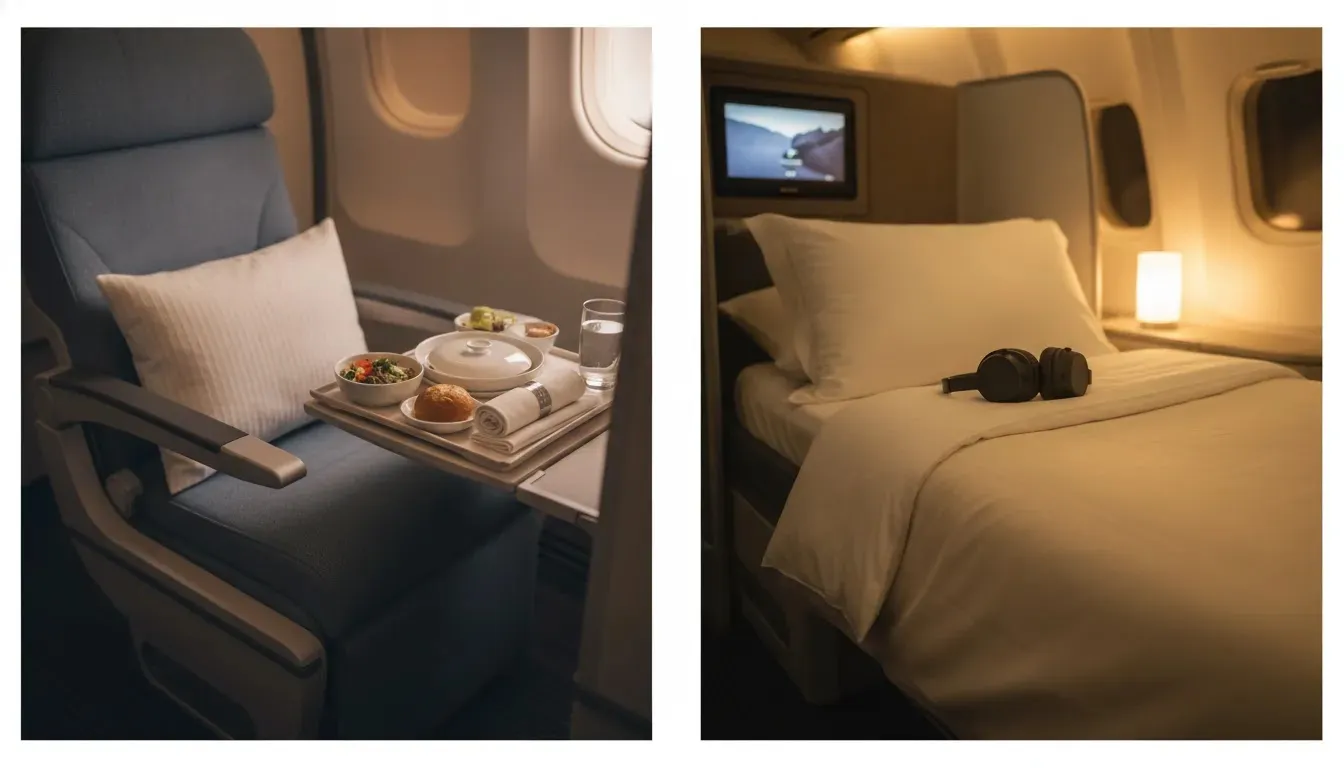
A cabin label can be misleading. Two tickets may both promise a premium experience, yet they serve different needs. One may simply make a long flight easier. The other may materially change how you sleep, work, dine, and move through the airport. If you want a clear grounding in what is business class, this comparison builds from that foundation and focuses on the practical differences that matter most on international travel.
Why This Comparison Matters
Premium Economy and Business Class are often discussed as neighboring cabins, but they are built for different purposes. Premium Economy typically improves the flight with more legroom, a wider seat, modestly enhanced dining, and a calmer cabin atmosphere. Business Class, particularly on long-haul international routes, usually aims to reshape the journey from curb to arrival with lie-flat seating, stronger privacy, lounge access, priority handling, and more individualized service.
For many discerning travelers, the question is not abstract. It comes up when planning an overnight crossing to Europe, a longer journey to Asia, or a milestone trip where arriving rested matters. On some daytime routes, Premium Economy may come surprisingly close to what you need. However, on overnight sectors or complex itineraries, the gap often widens.
This matters even more because airline products vary. A well-executed Premium Economy seat on one carrier may feel notably refined, while a weaker Business Class seat on a shorter route may not deliver the full long-haul experience travelers expect. If you are already weighing is Business Class worth it, the answer often depends on whether Premium Economy solves your real pain points or simply softens them.
Premium Economy vs Business Class at a Glance
| Criteria | Premium Economy | Business Class |
|---|---|---|
| Price | Premium Economy Flight Booking, typically $800 to $3,000 on long-haul international routes, subject to route and season | Business Class Flight Booking, typically $2,000 to $8,000+ depending on route, airline, and timing |
| Target user | Travelers who want a meaningful step above the main cabin without requiring a fully lie-flat product | Travelers who prioritize sleep, privacy, premium airport treatment, and a more comprehensive long-haul experience |
| Key strength | Noticeable comfort improvement with a lower commitment than a full premium-cabin fare | Lie-flat rest, stronger service levels, and a more complete end-to-end premium journey |
| Key weakness | Usually does not solve overnight sleep in the way Business Class can | The gap in value may narrow on short daytime routes or less ambitious regional products |
| Best for | Daytime long-haul flights, travelers who value seat space over ceremony, and those who may not need lounge access or a bed | Red-eyes, ultra-long-haul flights, demanding schedules, and trips where arriving rested is central |
| Worst for | Travelers expecting a near-Business-Class sleep experience or consistently premium ground privileges | Very short sectors where the cabin may not have time to justify its full premium proposition |
At a high level, choose Premium Economy if you mainly want more personal space and can tolerate sleeping in a recliner-style seat. Choose Business Class if your trip depends on real rest, stronger privacy, and reduced friction throughout the journey.
Which Airlines Do Premium Economy and Business Class Best?
The cabin name alone is never enough. Premium Economy and Business Class are not uniform categories, and the quality difference between airlines can be material. A strong Premium Economy product on a carefully configured long-haul aircraft may feel polished, spacious, and entirely satisfying for the right route. A weaker Business Class product on an older aircraft or shorter regional sector may carry the premium label without delivering the degree of privacy or sleep most travelers expect.
Why airline variation matters in premium economy vs business class
This variation is one reason experienced travelers often ask about specific carriers rather than cabins in the abstract. Airlines such as Emirates, Qatar Airways, Etihad Airways, Turkish Airlines, Delta, American Airlines, British Airways, Cathay Pacific, and Air India are all part of the conversation because each may offer very different seat designs, service flows, and route-specific experiences depending on the aircraft and destination.
For example, British Airways Premium Economy may be a reasonable step up for a daytime crossing. On another route, Qatar Airways or Cathay Pacific Business Class may offer a far more complete overnight experience because the seat, privacy, and bedding are designed around meaningful rest. If you want a broader carrier comparison, see best premium economy airlines.
Aircraft and route matter as much as the cabin name
Aircraft assignment matters just as much as airline reputation. A modern Business Class suite on a flagship long-haul aircraft may justify the upgrade very clearly. A dated Business Class cabin on an older configuration could feel less impressive, especially if direct aisle access is absent or the route is too short for the service to develop properly.
The same principle applies to Premium Economy. Some carriers provide a noticeably wider seat, leg rest, and thoughtful dining sequence. Others offer a narrower improvement that may feel closer to an extra-legroom main-cabin product than a distinct premium cabin. Therefore, a strong Premium Economy on one airline may outperform a weak regional Business Class on another.
For travelers comparing international itineraries to destinations such as Tokyo, India, Pakistan, or Nepal, this distinction becomes practical very quickly. The right answer may depend less on the cabin title and more on whether the actual aircraft, route timing, and service design match how you need to travel. For general seat guidance, the IATA cabin guidance also underscores how aircraft layout and cabin design shape the onboard experience.
Seat and Sleep Quality: Premium Economy improves comfort, Business Class changes the night
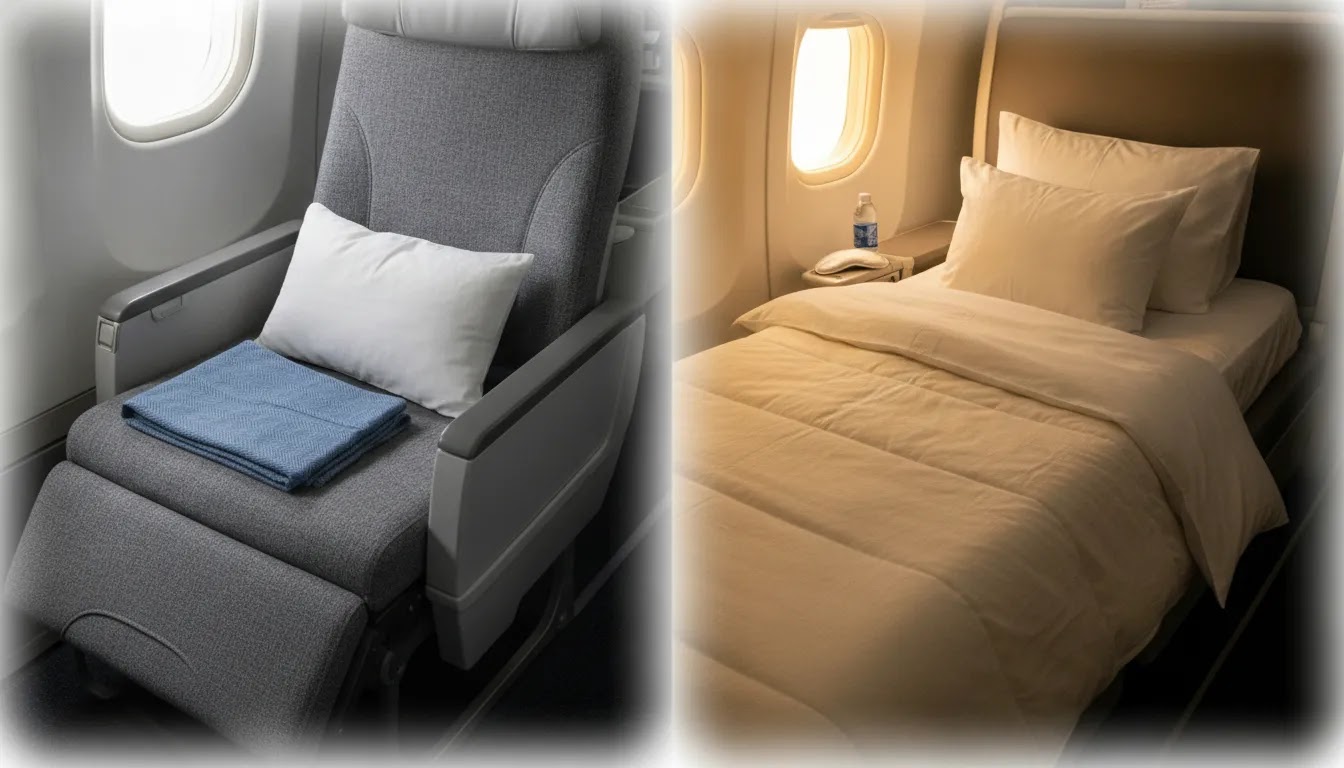
This is the single most important dividing line. Premium Economy seats are typically wider than the main cabin, with deeper recline, more pitch, leg support, and a quieter cabin zone. On a daytime transatlantic flight, that may be enough. You can read, dine more comfortably, and arrive feeling less compressed.
Business Class, by contrast, is usually designed around the idea that sleep is part of the product. On most intercontinental routes, that means a lie-flat or angled-flat seat, direct aisle access on better configurations, bedding, and more personal territory. Depending on the airline and aircraft, the difference may be the difference between resting briefly and sleeping for several meaningful hours.
Cabin design matters here. A modern Business Class suite on an Airbus A350 or Boeing 787 typically creates far more separation and control than Premium Economy can offer. Premium Economy still tends to feel like an upgraded shared cabin. Business Class often feels like a self-contained travel environment.
Winner on this dimension: Business Class. Premium Economy narrows the comfort gap, but it rarely closes the sleep gap on overnight international flights.
Airport Experience and Service Flow: Premium Economy adds convenience, Business Class usually adds priority
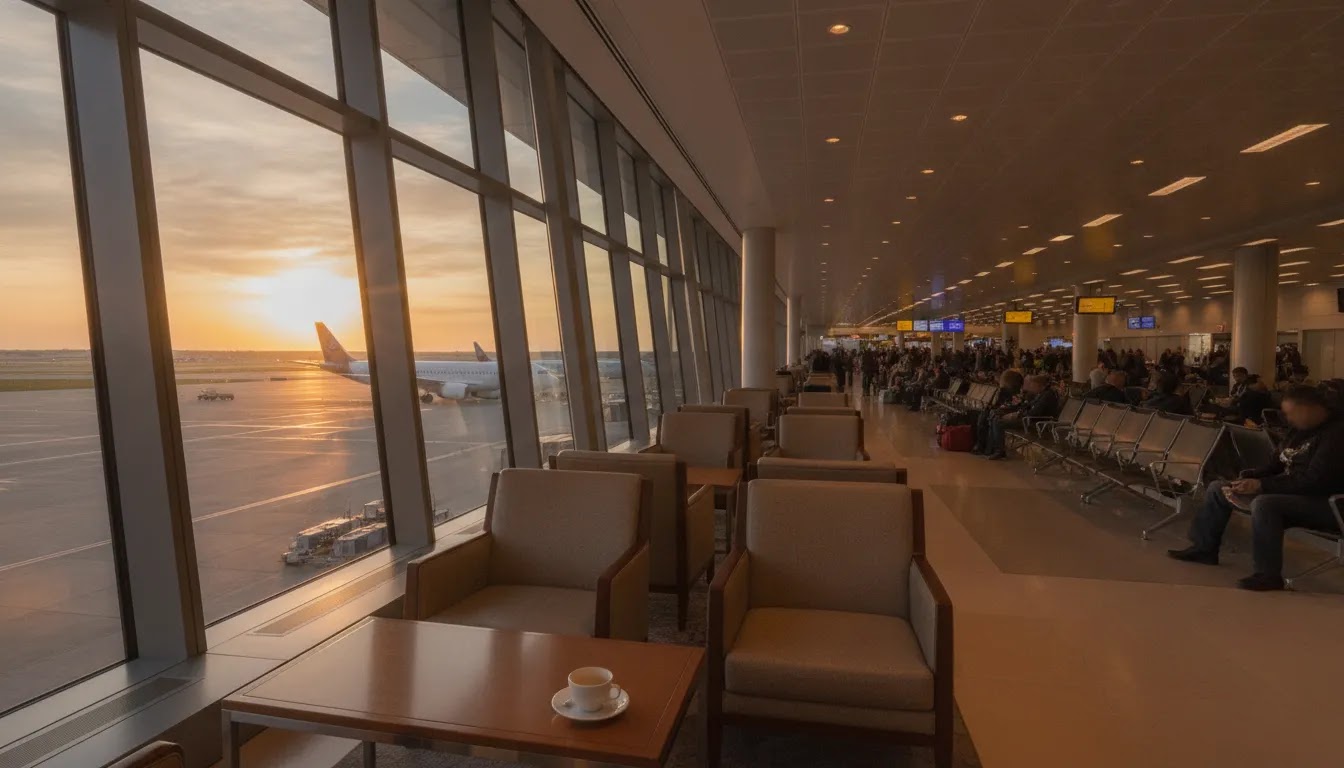
Many travelers focus first on the seat, yet the airport experience may shape your stress level before boarding even begins. Premium Economy may include priority boarding, dedicated check-in, and a more generous baggage allowance, depending on the airline and fare family. Those benefits can be useful, but they are not universal.
Business Class typically goes further. On most full-service carriers, you may receive premium check-in, faster baggage handling, lounge access, earlier boarding, and more attentive disruption support. On some airlines and airports, premium passengers may also encounter smoother security channels or more dedicated ground staff, though local execution varies.
This is one reason a broader comparison such as Business Class vs First Class can be useful later in your research. Once you move above Premium Economy, the conversation often shifts from seat measurements to service architecture. You may also want to review business class lounge access if airport privileges are central to your decision.
For travelers with connections, late departures, or important meetings after arrival, these ground differences can matter almost as much as the seat itself. Premium Economy may improve the airport day. Business Class more often reorganizes it in your favor.
Winner on this dimension: Business Class. Premium Economy may include helpful perks, but Business Class usually delivers a more complete premium flow.
Dining, Privacy, and Productivity: Premium Economy feels upgraded, Business Class feels purpose-built
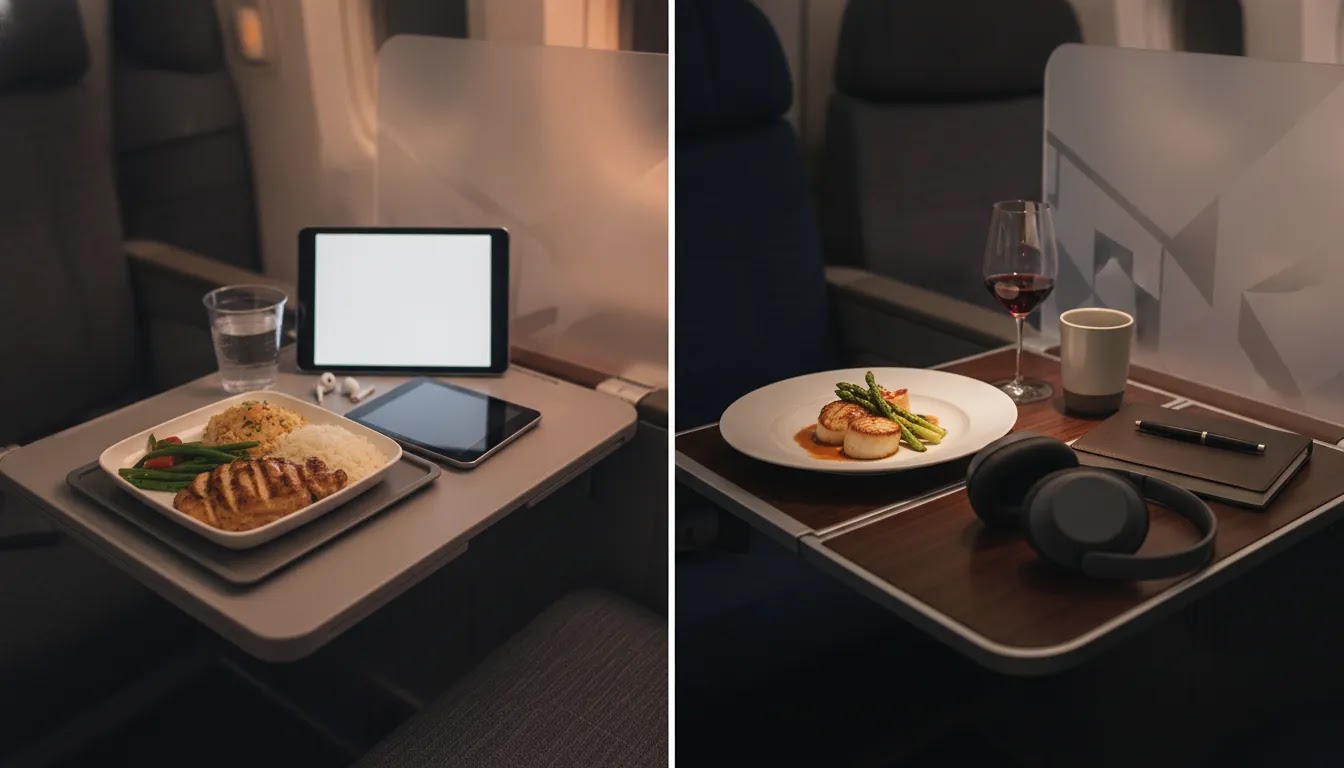
Premium Economy often offers better presentation, upgraded meals, and more personal space for dining than the main cabin. On well-run carriers, that can make the flight feel more composed and less transactional. For travelers who primarily want a better seat and a more pleasant meal, this may be enough.
Business Class generally adds a different level of control. The table space is usually more practical, the service is more individualized, and the cabin environment often makes it easier to work, rest, or simply withdraw from the surrounding activity. On routes where you need to review documents, dine in relative peace, or preserve energy for arrival, those distinctions become tangible.
Privacy is another major separator. Premium Economy may be calmer than the main cabin, but it remains an open shared environment. Business Class, depending on the airline, may include shell seating, doors, partitions, or suite-style layouts. That difference is not cosmetic. It affects noise, eye line, and how much the journey feels like your own.
Winner on this dimension: Business Class. Premium Economy improves the onboard experience, but Business Class is typically more effective for both work and personal comfort.
Entertainment, Wi-Fi, and Amenities
Beyond the seat itself, the soft product can widen or narrow the perceived gap between these cabins. Premium Economy may include a larger screen than the main cabin, improved headphones, a pillow and blanket set, bottled water, and in some cases a small amenity kit. On a well-run long-haul flight, those details may make the experience feel notably more composed than the main cabin, especially if you plan to read, watch films, or work intermittently during the journey.
Business Class usually goes further, though the extent varies by airline, aircraft, and route. Travelers may receive more substantial bedding, upgraded amenity kits, noise-canceling headphones, larger entertainment screens, better table space for devices, and more reliable charging options. On selected long-haul services, some airlines also provide loungewear, mattress pads, or more premium soft products, which readers often associate with carriers such as Emirates and certain Gulf or Asian long-haul operators. Wi-Fi access may also be easier to justify in Business Class because the cabin environment is better suited to uninterrupted work, even though onboard connectivity quality can vary significantly by aircraft and region.
These touches are valuable, but they should be weighed correctly. Amenity kits, bedding refinements, and improved entertainment hardware may enhance comfort. However, they do not carry the same importance as seat design, privacy, and genuine sleep potential. A polished Premium Economy service can feel excellent if your priorities are space and cabin calm. It still does not become Business Class simply because the headphones are better or the meal service is more elegant.
For most experienced travelers, the hierarchy remains clear. Soft products improve the journey around the edges. The seat still determines whether the cabin merely feels nicer or materially changes how you arrive.
Does Premium Economy Close the Gap? On some trips yes, on others not nearly enough
This is where the comparison becomes more nuanced. Premium Economy may come close enough if your main dissatisfaction with the main cabin is seat width, legroom, or a desire for a quieter atmosphere. That is often true on daytime flights to Europe, medium-length international sectors, or leisure trips where arrival condition matters but does not define the trip.
The gap usually stays wide on overnight travel. A better recliner is still a recliner. If you know that poor sleep affects your first day, your meetings, or your overall enjoyment, Premium Economy may feel like a respectable compromise rather than a true substitute.
Value also depends on fare spread. If Premium Economy is priced near the upper end of its range and Business Class is only moderately higher on a specific route, the superior sleep and service may justify the difference. Flight Experts currently assists with Premium Economy Flight Booking on long-haul international routes, typically from $800 to $3,000, and Business Class Flight Booking on major long-haul routes, typically from $2,000 to $8,000+, though exact pricing always depends on the airline, route, and timing.
For route context, readers comparing long-haul premium cabins may also want to review the broader premium cabin experience & amenities section and destination-specific Business Class options such as business class flights to Europe.
Winner on this dimension: scenario-dependent, but Business Class still leads overall. Premium Economy can be sufficient for selected trips. It usually does not replace Business Class where rest and premium service are central.
Premium Economy vs Business Class by Flight Type
The most practical way to choose between these cabins is to evaluate the actual journey pattern. A daytime transatlantic flight is a different decision from an overnight departure to Europe, and both differ again from a longer itinerary to Asia with one or more connections. The same traveler may make three different choices across those scenarios without being inconsistent.
Daytime and overnight premium economy vs business class decisions
On a daytime transatlantic route, Premium Economy may be entirely adequate if your main priorities are additional space, calmer surroundings, and arriving less fatigued than you would from the main cabin. Because sleep is not the central objective, the difference between a well-padded recliner and a lie-flat seat may feel less decisive. Business Class still offers better privacy, lounge access, and a more protected airport flow, but the incremental value may be less dramatic than it would be overnight.
An overnight long-haul flight usually changes the calculation. On departures where you board, dine, and have only a limited sleep window before arrival, Business Class often becomes meaningfully more valuable because the ability to lie flat may determine whether you arrive capable of functioning well the next day. Premium Economy may still be comfortable, but it typically asks you to manage the night rather than sleep through it with any consistency.
Longer routes and connections widen the gap
Ultra-long-haul travel to Asia tends to widen the gap further. On routes where the journey may involve many hours in the air, time zone disruption, and a demanding arrival schedule, Business Class often earns its place through accumulated advantages: a bed rather than a recliner, lounge time before departure, more personal space during the flight, and often a better rhythm for dining, working, and resting. For travelers heading to destinations such as Tokyo, Delhi, Mumbai, Karachi, or Kathmandu, that difference may shape not just comfort onboard but the first day or two of the trip.
Connecting itineraries also deserve special attention. If your trip involves a long layover, a tight connection, or irregular operations risk, Business Class may offer benefits that go beyond the seat itself. Lounge access can provide a more controlled environment between flights, and premium service channels may prove helpful if schedules shift. Premium Economy may still be the right cabin on a simpler point-to-point itinerary, but once multiple segments are involved, Business Class often carries compounding value that is easy to underestimate at booking.
That is why this comparison should always be grounded in the route, not just the cabin label. Premium Economy may be more than sufficient on selected international flights. Business Class usually becomes harder to replace once sleep, connection management, and arrival condition are all part of the decision. For consumer fare rules and service disclosures, the U.S. Department of Transportation air consumer resources can also be helpful.
Pros and Cons
Strengths
- Premium Economy may deliver a meaningful improvement in personal space, recline, and cabin calm compared with the main cabin.
- Business Class typically provides the strongest difference in sleep quality, especially on long-haul overnight sectors.
- Premium Economy can be an intelligent middle ground for travelers who value comfort but do not need a bed or lounge access on every trip.
- Business Class usually includes a more coherent premium experience across check-in, boarding, baggage, dining, and onboard service.
- Both cabins can be worthwhile depending on route length, departure time, and the condition in which you need to arrive.
Considerations
- Premium Economy benefits vary considerably by airline, aircraft, and fare rules, especially for lounge access and airport privileges.
- Business Class is not uniform. A regional recliner product may not deliver the same value as a true long-haul lie-flat cabin.
- The cabin name alone is not enough. Aircraft type, seat configuration, and route timing often matter more than branding.
- On some daytime routes, the extra investment in Business Class may feel less decisive than it would on an overnight flight.
Who Each Cabin Usually Suits
Premium Economy usually suits travelers who want to arrive in better condition than they would from the main cabin, but who do not necessarily require full horizontal sleep. It often works well for leisure travelers on daytime crossings, couples who value comfort but not full premium ceremony, and travelers who prefer investing in the destination while still improving the journey.
Business Class generally suits travelers whose schedules, health, or trip purpose make genuine rest and reduced travel friction more important. That may include executives flying straight into meetings, couples planning a milestone itinerary, families managing demanding long-haul connections, or anyone who knows that the journey itself can affect the success of the trip.
Flight Experts Perspective
At Flight Experts, the choice between these cabins is usually approached route first, not label first. A Premium Economy seat may be entirely sensible on a daytime Atlantic crossing, while the same traveler on an overnight flight to Asia could benefit far more from a carefully selected Business Class product. That is where product knowledge matters. Aircraft type, seat generation, connection time, airport lounge access, and schedule quality often shape the outcome more than marketing terminology.
Flight Experts offers both Premium Economy Flight Booking and Business Class Flight Booking, with a personal travel consultant, seat selection support, meal preference coordination, and booking guidance tailored to your route. If you are comparing premium cabins for an important journey, you may explore the services available at Flight Experts or connect with Mike Chirilenco and the team for a personalized recommendation based on how you actually travel.
How to Choose Well Between Premium Economy and Business Class
The strongest decision usually comes down to five practical questions.
- Is the flight overnight? If yes, ask whether you merely want more comfort or whether you truly need sleep. Premium Economy may improve the night. Business Class may preserve the next day.
- How important is your arrival condition? If you are heading into meetings, a cruise departure, a celebration, or a complex onward connection, the premium may be more justifiable.
- What aircraft is operating the route? A modern lie-flat Business Class seat on a long-haul aircraft often creates a very different value equation than an older or regional product. Premium Economy also varies widely in pitch, width, recline, and leg support.
- Which ground benefits are actually included? Premium Economy may or may not include the airport privileges you expect. Business Class usually includes more, but details still depend on airline and airport.
- How long is the sector? On a shorter daytime route, Premium Economy may cover most of your needs. On ultra-long-haul or multi-segment itineraries, Business Class often has compounding advantages.
For travelers trying to decide in principle, the answer is rarely ideological. It is situational. Premium Economy can be the right cabin for a comfortable, sensible premium journey. Business Class becomes difficult to replace once your trip depends on sleep, privacy, and a more protected travel rhythm.
Frequently Asked Questions
Is Premium Economy worth choosing over Economy?
In many cases, yes. Premium Economy typically offers more seat width, extra legroom, greater recline, and a calmer cabin environment than the main cabin. On medium and long-haul flights, that can make a meaningful difference to comfort. It is most appealing when you want a better journey but do not require the full service structure or bed-like seating associated with Business Class.
Is Business Class always worth the extra investment over Premium Economy?
Not always. The answer usually depends on route length, departure time, aircraft type, and how important your arrival condition is. On a daytime flight, Premium Economy may cover much of what you need. On an overnight long-haul journey, Business Class often justifies itself more clearly because the sleep and privacy advantages are usually much greater.
What is the biggest difference between Premium Economy and Business Class?
The largest difference is usually sleep capability. Premium Economy generally offers a larger reclining seat, while Business Class on long-haul international routes often provides a lie-flat bed and more privacy. That distinction tends to shape everything else, including how rested you feel, how much space you have, and whether the cabin feels upgraded or transformational.
Does Premium Economy include lounge access?
Usually not as a universal rule. Some airlines may sell packages, offer access through elite status, or include lounge entry on select fares, but Premium Economy should not be assumed to include it. Business Class is far more likely to include lounge access as part of the ticket, though partner access rules and station-specific exceptions may still apply.
Can Premium Economy feel close enough to Business Class on international flights?
It can, but usually only in selected circumstances. On daytime routes where sleep is not central, the added seat space and quieter cabin may satisfy many travelers. On overnight or ultra-long-haul flights, the gap often remains substantial because Premium Economy rarely reproduces the lie-flat rest, privacy, and service level that define strong Business Class products.
Does Business Class always mean lie-flat seating?
No. On long-haul international routes, lie-flat seating is common and often expected. On shorter regional or domestic routes, Business Class may be a recliner-style product with improved service and more space, but not a bed. That is why it helps to review the exact aircraft and seat map rather than relying on the cabin label alone.
Which cabin is better for couples on a leisure trip?
That depends on the style of trip. Couples on a daytime journey may find Premium Economy entirely satisfying if they want more comfort and a calmer atmosphere. For honeymoons, anniversaries, or long overnight flights where the journey is part of the occasion, Business Class may feel more aligned with the experience they want from departure onward.
How should frequent business travelers choose between the two?
Frequent business travelers often benefit most from Business Class when sleep, productivity, and airport efficiency have a direct effect on performance. Premium Economy can still make sense on shorter or daytime sectors where a full premium cabin is not essential. The deciding factor is usually whether the traveler needs real recovery time or simply a more comfortable working environment.
Can you sleep on Premium Economy?
Yes, many travelers can sleep in Premium Economy, particularly on daytime flights where only light rest is needed or on overnight routes if they are naturally able to sleep in a reclined seat. The limitation is consistency. Premium Economy may improve your chances of resting compared with the main cabin, but it usually does not offer the body position, privacy, or uninterrupted comfort that make Business Class more reliable for several hours of meaningful sleep.
Is Premium Economy equal to Business Class?
No. Premium Economy is a meaningful upgrade from the main cabin, but it is not typically designed to match Business Class. The seat, service level, airport privileges, privacy, and sleep quality are usually different in ways that become especially clear on overnight and long-haul international flights. On some daytime routes, a strong Premium Economy product may feel sufficient enough that the gap matters less, but the cabins are still built to deliver different outcomes.
Which class is the highest in flight?
On airlines that offer it, First Class is generally the highest cabin, above Business Class. Many carriers, however, no longer operate an international First Class cabin and position Business Class as their top premium product. The hierarchy therefore depends on the airline and route. For a given itinerary, it is often more useful to examine the actual product than the label alone.
Where should you not sit on a plane?
There is no universal answer, because the least desirable seat depends on the aircraft, route length, and your priorities. In most cases, travelers seeking rest may wish to avoid seats near lavatories, galleys, bassinets, or high-traffic cross-aisles, where noise and light can be more disruptive. In premium cabins, it is also worth checking whether a seat has reduced privacy, restricted footwell space, or less convenient storage. Reviewing the exact aircraft layout is usually more useful than relying on general assumptions.
Quick Recap
Pick Premium Economy if you want a clear step above the main cabin and your trip does not depend on lie-flat sleep. Pick Business Class if the journey itself must protect your time, energy, and arrival condition.
| Option | Best for | Typical price context |
|---|---|---|
| Premium Economy Flight Booking | Daytime long-haul comfort, extra space, and moderate premium service | Typically $800 to $3,000, depending on route and season |
| Business Class Flight Booking | Overnight long-haul travel, sleep, privacy, and stronger airport privileges | Typically $2,000 to $8,000+, depending on route and airline |
Key Takeaways
- Premium Economy improves comfort meaningfully, but it usually does not replicate the sleep benefits of Business Class.
- Business Class tends to justify itself most clearly on overnight and ultra-long-haul international routes.
- On daytime flights, Premium Economy may close enough of the gap for many travelers to skip Business Class.
- Aircraft type, route timing, and included ground services often matter more than the cabin label alone.
- For a high-value itinerary, expert guidance may help match the cabin to the actual demands of the trip.
Conclusion
The decisive difference between these cabins is not prestige. It is whether you need a better seat or a meaningfully better journey. Premium Economy can be a refined, practical choice when more space and a calmer cabin are enough. Business Class becomes the stronger choice when sleep, privacy, premium ground handling, and arrival condition are central to the success of the trip. If you would like route-specific guidance, Flight Experts can help you compare real cabin products rather than broad labels. Speak with Mike Chirilenco or the Flight Experts team to discuss your itinerary and receive a personalized recommendation tailored to how you travel.



