
Business Class Cost on International Flights (2026)

Overview
The business class international flight cost most travelers encounter in 2026 typically sits inside a broad range, not a single predictable number. According to current Flight Experts service data, business class flight booking commonly falls between $2,000 and $8,000+, depending on route and airline. That range covers key corridors such as the US to Europe, US to Asia, US to the Middle East, US to Australia, and select domestic US premium routes. In practice, a transatlantic fare on an older product may price very differently from a flagship transpacific suite with direct aisle access and premium ground services.
What matters is not just fare level, but what you are actually buying. Some itineraries include highly regarded products such as Qatar Airways Qsuite, Singapore Airlines long haul business class, Lufthansa, ANA, JAL, Delta One, United Polaris, or American Airlines Flagship Business. Others may involve less competitive seat layouts, weaker lounge access, or unattractive connection timing. Readers comparing business class cost across carriers should evaluate the full travel proposition, not the number in isolation.
Flight Experts positions this process as a consultative service. The agency handles premium flight bookings with a personal travel consultant, seat selection guidance, meal preference support, check in assistance, price drop monitoring, and cabin upgrade alerts. Relevant category resources on Discounted Business & First Class Deals and Premium Flight Booking & Tips help frame the broader premium booking context, but this article is focused on decision stage questions around actual international pricing.
Typical Price Bands by Route Type
The same published range can feel very different depending on where you are going and how airlines typically deploy premium capacity on that corridor. Within the Flight Experts benchmark range of $2,000 and $8,000+, transatlantic routes between the US and Europe often cluster toward the lower to mid portion of that band in many seasons, simply because there is frequent service, multiple competitive gateways, and more opportunities to construct a strong itinerary without paying for the most capacity constrained markets.
Transpacific travel, and especially US to Australia, more commonly leans toward the upper portion of the range in most cases. Stage length is longer, premium demand is often consistent year round, and nonstop options may be limited from certain US cities. US to the Middle East can span the full spectrum, but premium heavy routes served by carriers known for flagship business class cabins and polished ground services may sit higher, particularly on nonstop long haul segments.
How much the departure gateway and connection strategy influence the fare and the lived experience is often underestimated. Departing from a major hub may open access to more carriers and more nonstop departures, which can support better timing and, at times, more competitive pricing. Departing from a secondary city may require an extra segment or a less desirable connection, which can move the number and also change what portion of the trip is truly premium. A connection can be a sensible trade if it preserves sleep, reduces total travel friction, and keeps the long haul leg on the strongest aircraft and cabin version. It can be a poor trade when it adds an awkward overnight layover, forces a short premium segment with limited service value, or introduces unnecessary misconnect risk.
The Experience

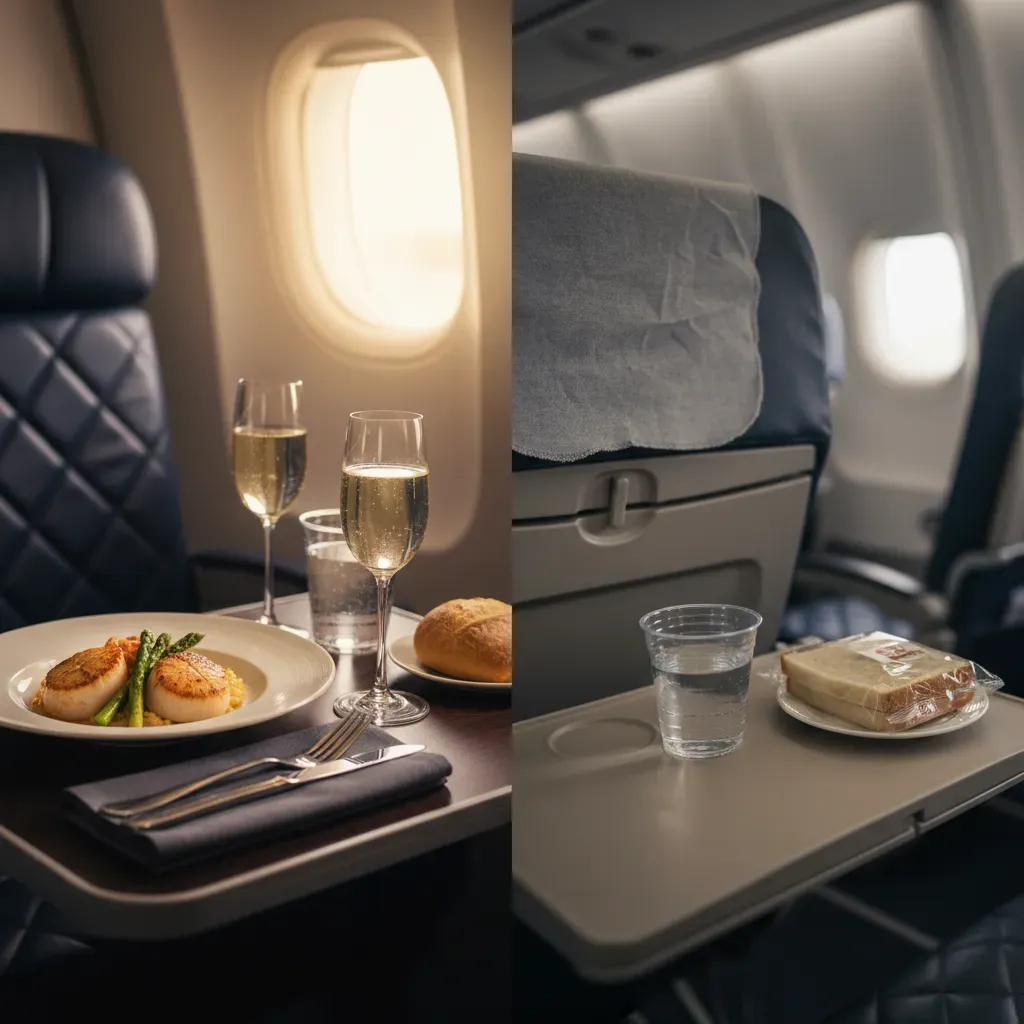
At the upper end of international aviation, business class is designed to restore time, privacy, and physical comfort. On strong long haul products, travelers can expect lie flat seating, direct aisle access on many modern aircraft, upgraded bedding, multi course dining, improved wine and spirits programs, more attentive cabin service, and airport lounge access. On some routes and carriers, the difference begins on the ground with priority check in, fast track security access where available, and a quieter pre departure environment.
That said, business class is not uniform. An international business class price may reflect a world class suite on one carrier and a dated angled or denser configuration on another. This is precisely why published fares alone can mislead. A lower quote may correspond to an inferior hard product, a long overnight connection, or mixed cabin segments that dilute the overall value. If your question extends beyond cost to is business class worth it, the answer usually depends on route length, sleep needs, schedule demands, and product quality.
Flight Experts structures the booking process simply: submit a request, an expert is assigned at no charge, options are usually presented within 30 minutes, then the client selects and books. For discerning travelers, that process can be more valuable than endless self-directed searching because it narrows the field to realistic, premium-fit options. It is especially useful for travelers considering Emirates, Qatar, Singapore, Lufthansa, British Airways, ANA, JAL, Delta One, United Polaris, or American Airlines, where route, aircraft type, and cabin version can meaningfully change the experience.
Investment and Value
For readers asking about the average cost business class international options command in 2026, the current Flight Experts range of $2,000 to $8,000+ is the most grounded starting point. The lower end may appear on shorter premium routes, less in-demand travel periods, or selected city pairs. The upper end, and beyond, is more common on long haul nonstops, peak travel windows, premium heavy routes, or top tier carriers with sought after cabin products.
Several factors shape international business class ticket price levels. Route geography is one. US to Europe often prices differently from US to Asia or Australia because stage length, demand, and aircraft deployment differ. Timing is another. Holiday periods, school breaks, major events, and late booking windows can push fares materially higher. Carrier and aircraft matter as well. A newer suite style seat with superior lounge access and a strong soft product may command a premium over a less competitive configuration.
Flight Experts also notes typical savings of up to 25 to 60 percent off published fares for business class bookings, subject to route, inventory, and airline conditions. Those results are not guaranteed, and availability varies, but they help explain why many premium travelers use a specialist rather than relying only on public search engines. If you are comparing broader ticket prices, it is wise to assess schedule quality, aircraft type, fare rules, and after booking support alongside the fare itself.
A useful point of perspective: the right international business class fare is not necessarily the absolute lowest one. It is the fare that delivers the most appropriate cabin, timing, service continuity, and flexibility for your trip objective, whether that means a honeymoon departure, a client meeting arrival, or a multi stop long haul journey.
What Changes the Price Most in Practice
Itinerary construction often changes the final number more than travelers expect. A routing that looks attractive on paper can sometimes include mixed cabin segments, where one or more legs are not truly business class. That could be a short positioning segment, a regional hop, or a connection that places you in a less premium cabin on a meaningful portion of the journey. The headline fare may still read as business class, yet your sleep, lounge access continuity, and overall arrival condition can be materially different depending on where the premium cabin is actually delivered.
Long layovers and connection logic can also distort value. A connection can be reasonable when it protects an overnight sleep window on the long haul, keeps you on a preferred aircraft and cabin version, and avoids punitive arrival times. It becomes less compelling when it creates an extended overnight wait, splits the premium experience across two mediocre segments, or compresses the connection into a time window that increases misconnect exposure. In many cases, a well planned connection is about quality control, not just routing.
Fare rules are another area where two similar prices can behave very differently if plans shift. Change and cancellation conditions, ticketing deadlines, and who controls the ticket after issuance all influence real world flexibility. A fare that appears comparable in price may be far less workable if it imposes restrictive reissue rules, steep penalties, or limited inventory for changes. For premium travelers with business obligations or complex trip elements, those rules can be part of the value equation, not an afterthought.
Aircraft type and cabin version also matter operationally, not only aesthetically. The same airline may fly different configurations on the same route across the week, and schedules can be subject to equipment changes. Verifying the aircraft, seat layout, and the marketed cabin product before ticketing, and monitoring for changes after ticketing, helps ensure you are buying the premium experience you intended. This is one reason many clients prefer an advisor to validate the long haul segment, confirm the cabin version where possible, and flag meaningful schedule or equipment shifts when they occur.
Strengths and Considerations

Strengths
- Current Flight Experts service coverage includes major international business class routes from the US to Europe, Asia, the Middle East, Australia, and domestic premium sectors.
- The service includes a personal travel consultant rather than anonymous platform support, which matters when schedule quality and cabin product vary significantly by route.
- Options are usually presented within 30 minutes, which is especially valuable for busy travelers who do not wish to sort through dozens of inconsistent fare displays.
- Support extends beyond ticket issuance to seat selection, meal preferences, check in assistance, price drop monitoring, and cabin upgrade alerts.
- Coverage spans major premium carriers including Emirates, Qatar, Singapore, Lufthansa, British Airways, ANA, JAL, Delta One, United Polaris, and American Airlines.
- Trustpilot data supplied in the product feed shows a 5.0 rating from 79 reviews, an encouraging signal for service reliability and client satisfaction.
Considerations
- Business class pricing remains highly variable, so no single international business class price can be treated as universal across all routes and dates.
- Even within the same airline, cabin experience may differ by aircraft and route, so travelers should not assume all business class seats are equivalent.
- Premium fare opportunities are subject to availability and may move quickly, particularly during peak long haul travel periods.
- Travelers seeking a purely self-service booking process may prefer an online tool, though that usually comes with less context, less accountability, and less tailored guidance.
First Class vs Business Class Pricing
Many premium travelers reach a natural comparison point, whether first class is worth considering when the goal is a superior long haul experience. On international routes, first class can price far above business class in most cases, but the gap is not consistent. It varies by airline strategy, route demand, season, and whether the carrier is operating a true international first class cabin on that specific aircraft. Some airlines offer first class only on select routes, which can tighten availability and keep pricing elevated. Other markets may show a narrower gap at specific times, particularly where business class inventory is strong and first class demand is more variable.
What first class may add beyond business class is typically less about the bed, and more about privacy and the full journey orchestration. Depending on carrier and route, this could include a more private suite, more elaborate dining, stronger wine programs, and elevated ground services such as dedicated check in areas or more exclusive lounge environments. These features are subject to change by airport and aircraft, and they can differ substantially even within the same brand.
Business class is often the more rational premium choice when sleep quality and arrival readiness are the primary goals, especially on modern products with direct aisle access and well designed bedding. First class becomes more compelling when privacy expectations are higher, when the ground experience is a meaningful part of the trip, or when the traveler values a quieter, more individualized service rhythm. Consistency also matters. If only one segment offers first class while other long haul segments remain business class, the overall experience may not feel proportionate to the additional investment. Evaluating the cabin across the entire itinerary, including aircraft type and the specific long haul legs, is usually the most reliable way to decide.
Who This Experience Is For
This service is best suited to travelers who place a high value on time, comfort, and professional guidance. That includes couples planning anniversary or honeymoon travel, executives flying long haul with little tolerance for schedule missteps, families organizing premium multi destination journeys, and frequent travelers who want one informed point of contact. It is also well suited to readers exploring cheap business class in the sense of better structured premium fares, while still expecting a polished and properly managed experience rather than a bargain-first approach.
How to Begin Planning With a Specialist
Flight Experts is led by Mike Chirilenco and positioned as a concierge-style luxury travel agency for clients who prefer expert management over impersonal booking flows. The process begins by submitting a request through the website with your route, preferred dates, cabin preference, and any scheduling priorities. An expert is then assigned without charge, and options are usually returned within 30 minutes for straightforward business class requests.
From there, the value lies in refinement. The consultant can help compare airlines, identify stronger cabin products, coordinate seat preferences, and clarify the trade offs between nonstop convenience, connection quality, and fare level. This is particularly useful on complex long haul itineraries, alliance-heavy routings, or premium trips where the cost of a poor choice is measured in time and comfort, not only dollars.
For travelers ready to move forward, the most sensible next step is a direct conversation. Speak with a luxury travel specialist at Flight Experts, share your priorities, and allow Mike and the team to present business class options aligned with the way you actually travel.
Frequently Asked Questions
How much does business class cost on an international flight in 2026?
Based on current Flight Experts product data, business class flight bookings typically range from $2,000 to $8,000+, depending on route, airline, and timing. A shorter transatlantic itinerary may price very differently from a premium transpacific or Australia routing. Aircraft type, fare rules, and season also affect the final number.
Why does one international business class fare cost so much more than another?
Price differences often reflect cabin quality, route demand, aircraft configuration, connection logic, and booking timing. A newer suite product on a flagship route may justify a higher fare than an older seat on a less desirable schedule. Some fares also include stronger change conditions or more convenient departure patterns, which can materially affect value.
Is it better to book business class independently or through a specialist?
For straightforward travelers with flexible standards, independent booking may appear simple. For premium travelers who care about product consistency, seat quality, support, and itinerary fit, a specialist is often the wiser choice. Flight Experts adds human evaluation, schedule scrutiny, and post booking support that public booking engines typically do not provide.
What is included when Flight Experts books business class travel?
According to current service data, clients receive support from a personal travel consultant, along with seat selection assistance, meal preference coordination, check in help, price drop monitoring, and cabin upgrade alerts. The goal is not only to issue a ticket, but to manage the premium travel experience more carefully from selection through departure.
How quickly can Flight Experts provide business class options?
For business class flight booking inquiries, options are usually presented within 30 minutes, based on the current product information. More complex requests may take longer, particularly if the itinerary involves multiple destinations, open jaw routing, or specific airline preferences. Timing can also vary with market conditions and request detail.
Does a higher business class price always mean a better experience?
Not always. A higher fare may reflect stronger demand rather than a superior seat or service standard. The important question is whether the fare buys a meaningfully better product, timing, or flexibility. Experienced review of the route and aircraft is essential, especially when comparing major international carriers across different long haul markets.
Can Flight Experts help with more complex premium itineraries?
Yes. Current product data also shows a Complex Itinerary Planning service for multi city, open jaw, and round the world style journeys in business or first class. That service may be especially useful when separate tickets would create unnecessary risk, poor connection logic, or a fragmented premium experience.
How much does an international business class flight cost?
International business class pricing typically falls within the current Flight Experts range of $2,000 to $8,000+, with the final number shaped by route type, season, airline, and how the itinerary is constructed. In most cases, US to Europe corridors can present more variability and more opportunities within the lower to mid portion of that band, while longer haul markets such as parts of Asia and Australia more often skew higher due to stage length and limited nonstop capacity.
Is business class worth it for international travel?
For many experienced travelers, business class is worth it when the route length and schedule make sleep and arrival readiness nonnegotiable. The value is strongest on overnight long haul flights where a lie flat seat materially changes how you feel on arrival, and when the itinerary is built around a high quality long haul product. It can be less compelling if the trip includes mixed cabin segments, poor connection timing, or a dated configuration that does not deliver meaningful privacy or rest.
What is the cheapest way to buy a business class ticket?
The most reliable approach is usually not a single tactic, but a disciplined focus on itinerary quality and flexibility. In practice, selecting competitive city pairs, being open to a well timed connection, and avoiding mixed cabin segments that dilute the premium value can help identify better structured pricing. Working with a specialist may also surface private or consolidator style fares that are not consistently displayed to the public, subject to availability and airline conditions.
Is it cheaper to fly business class or first class?
Business class is typically less expensive than first class on international routes, but the difference can vary widely by airline, route, and whether first class is offered on that specific flight. On certain markets and dates, the gap may narrow relative to what travelers expect, but first class is often positioned as a limited capacity, higher touch product with more exclusive ground services and greater privacy. The sensible choice is usually the one that matches your sleep needs, privacy expectations, and consistency across the full itinerary.
Key Takeaways
- International business class in 2026 typically falls within a wide range, with current Flight Experts data showing $2,000 to $8,000+ depending on route and airline.
- Published fare level alone does not define value, cabin product, aircraft, schedule quality, and support all matter.
- Flight Experts provides a personal consultant, usually fast turnaround, and premium booking support that extends beyond the initial search.
- Modern business class can transform long haul travel, but the quality gap between carriers and routes remains significant.
- For discerning travelers, specialist guidance often reduces risk and improves fit more effectively than self-service booking tools.
Conclusion
The question is not only how much does business class cost international flight options in 2026, but what level of comfort, efficiency, and service that fare actually delivers. Current Flight Experts data provides a useful benchmark, yet real value comes from matching the right fare to the right route, cabin, and traveler. That is where expert judgment becomes more important than another round of online searching. Flight Experts, led by Mike Chirilenco, offers a more tailored path for travelers who want premium options evaluated properly and managed with care. If you are planning an international journey and want clarity on business class international fare options, contact Mike to begin planning with a specialist who understands the expectations that come with premium travel.



