
Flying First Class With Kids: Tips & Airlines

Bringing children into First Class changes the decision in meaningful ways. The question is not only whether the cabin is luxurious, but whether the airline’s policies, privacy features, seat layout, and service style actually suit your family. It can also be less practical than expected if a carrier restricts young travelers in certain cabins or if the suite design limits easy interaction between parent and child. For families weighing that investment, the right answer usually depends on age, route, aircraft, and travel goals. If you are still assessing the broader value question, is first class worth it is the right starting point before narrowing your family-specific options.
Why family first class travel works differently
Adults booking First Class for themselves often focus on privacy, exclusivity, lounge quality, and onboard dining. Families need to judge those same features through a different lens. A highly enclosed suite may feel exceptional for a solo traveler. However, it can create friction when you need to help a child during takeoff, bedtime, or a midflight meal. By contrast, a slightly more open cabin can be easier for a parent supervising younger children.
The strongest family first class flight setups usually combine several traits. They offer a manageable seat map, attentive cabin crew, sensible bassinets or child meal handling where applicable, and aircraft layouts that let family members sit close enough to help one another. Overnight flights benefit most. As a result, a well-chosen family first class flight may reduce the fatigue that often follows late departures, long sectors, and disrupted sleep.
This matters most on transpacific and long transatlantic services, where Flight Experts’ First Class Flight Booking service typically supports travelers on routes from the US to Europe, Asia, and the Middle East. Current pricing generally ranges from $5,000 to $20,000+ depending on carrier and itinerary. That range underscores why families should review the product carefully rather than assume any First Class seat will feel equally suitable.
Which airline features matter most on a family first class flight
Not every premium cabin handles families in the same way. Some airlines are warmly accommodating to children in their most exclusive cabins. Others may have age-related practices, quieter cabin expectations, or seat designs better suited to older children than toddlers. Policies may vary by route, aircraft, and operating carrier, so direct confirmation remains essential.
Seat proximity is usually the first consideration. Parents should verify whether two adjacent suites actually allow practical communication. In some cases, suite walls and door placement make the cabin feel more segmented than expected. If you want a deeper look at layouts, review first class airplane seats.
Bed conversion and sleeping comfort matter most on overnight flights. Children who can settle into a proper lie-flat bed, with bedding sized appropriately and minimal cabin noise, generally arrive in far better condition. That can be especially valuable when you have immediate onward ground transfers or a tight touring schedule.
Ground experience also shapes the family journey. Dedicated check-in, expedited assistance, premium lounges, and in some cases chauffeur coordination may remove pressure from the airport process. For parents traveling with younger children, that smoother pre-boarding period can be almost as valuable as the seat itself. Readers interested in broader premium cabin amenities can also explore Premium Cabin Experience & Amenities.
Service culture may be the deciding factor. The finest crews usually adjust pacing, meal timing, and interaction style with tact. They understand when a family wants help and when it wants privacy. That kind of judgment may transform a premium flight from merely comfortable into genuinely restorative.
Family first class flight seating strategies by age and travel stage
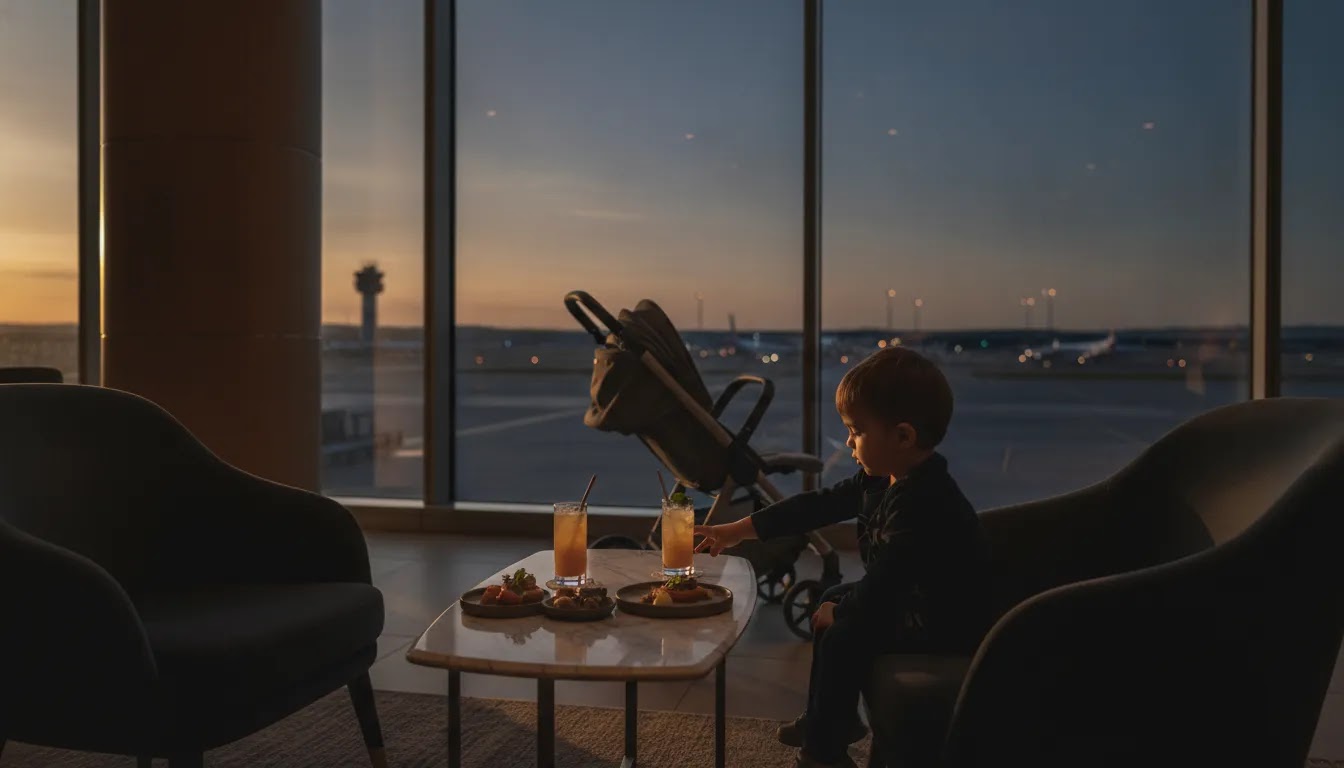
Seat selection becomes far more nuanced once you match the cabin to a child’s age and degree of independence. Toddlers usually need the easiest physical access, not the highest degree of enclosure. In many First Class cabins, that may mean adjacent seats with simpler sightlines. A more open arrangement also lets a parent reach over quickly during meal service, bedtime, or restless moments. A fully enclosed suite can be elegant, yet it may feel less practical if one adult must stand up often to assist.
Family first class flight seating for younger children
School-age children often sit in the middle ground. They may enjoy the excitement of a private suite, but many still benefit from being close enough for easy reassurance and direct supervision. Center pairs can work very well if the divider configuration allows natural conversation and if the suite doors do not create unnecessary separation. On some aircraft, families may prefer a cabin with fewer visual barriers rather than the most exclusive layout on paper.
Teenagers are usually the easiest fit for highly private First Class products. A self-assured older child may appreciate independent space, especially on a long overnight route where uninterrupted sleep matters. Even then, parents should not assume any adjacent pair is equally suitable. Some suites appear close on a seat map but feel surprisingly disconnected once privacy walls, aisle placement, and bed orientation are taken into account.
Family first class flight supervision and sleep support
Bedtime support is another factor families should weigh before committing to a specific seat pair. If your child may need help settling in, changing into sleepwear, managing bedding, or timing a late meal around rest, the most convenient seats are not always the most visually impressive ones.
Families should also consider whether one parent may need to monitor sleep during the flight. In addition, they should ask whether the crew can pace dining earlier for a child and whether the chosen seats make midflight supervision realistic without repeatedly crossing the cabin. Those details often determine whether a family first class flight feels restorative or merely elaborate.
Top picks at a glance
| Airline type | Best for | Why families consider it |
|---|---|---|
| Suite-based First Class with center options | Parents traveling with one older child | High privacy, excellent sleep quality, refined service |
| Open First Class layouts with low seat count | Families wanting easier visual contact | Simpler supervision and less separation between seats |
| First Class with strong ground service | Families with connections or late-night departures | Check-in, lounge access, and calmer airport flow may reduce strain |
| Large premium carriers serving Asia or the Middle East | Long-haul family vacations | Often offer more polished long-haul First Class consistency |
Where to find the most family-friendly First Class options
Families searching for First Class with children are usually looking in a few specific regions rather than across the entire global market. Long-haul service to Asia often presents the strongest fit because many flagship cabins on those routes were designed with sleeping comfort, attentive hospitality, and quieter overnight service in mind. Flight Experts maintains route-specific planning support for First Class Flights to Asia, which is often where families find the most compelling balance of comfort and duration.
Europe can also work well, especially for milestone trips or multi-city holidays, though route length is a practical factor. On shorter overnight sectors, some families may question whether First Class delivers enough incremental rest compared with an excellent Business Class product. For families who still want the highest cabin on select transatlantic services, route review and aircraft confirmation are critical. Relevant options can be explored through First Class Flights to Europe.
The Middle East remains important for families continuing onward to Africa, Asia, or the Indian Ocean. Carriers in this region often emphasize polished ground handling, premium lounges, and aircraft with strong flagship products. That said, suite style and onboard social layout may differ considerably. Some are magnificent for couples but less intuitive for a parent seated one row away from a young child. A detailed seat plan review is advisable before ticketing.
If you are comparing cabins beyond First Class, the broader Premium Flight Booking & Tips section may help frame the trade-offs between exclusivity and practicality.
Pros and Cons
Strengths
- First Class may make long-haul family travel far more restful, particularly on overnight itineraries where proper beds and a quieter cabin support better sleep.
- Premium ground services, such as dedicated check-in and lounge access, often reduce airport stress before departure.
- Lower passenger counts generally allow more attentive, personalized service, which may help with meal timing, bedding setup, and family pacing.
- Spacious seating gives parents more room to manage children’s comfort items, inflight routines, and personal space.
- For milestone family travel, First Class can create a more composed and memorable start to the journey.
Considerations
- Some suite-heavy products prioritize privacy so strongly that assisting a child may be less convenient than expected.
- Airline policies for infants and young children may vary, and some products may not be ideal for very young travelers.
- The premium investment is substantial, so the cabin should be matched carefully to route length, child age, and family priorities.
- Availability in true international First Class is limited compared with Business Class, especially on specific dates and aircraft.
When Business Class may be the better family choice
For some families, the most intelligent premium booking is not First Class at all. Business Class may outperform First Class when children are very young, when parents want easier physical access throughout the flight, or when the route is not long enough to fully justify a more secluded flagship cabin. An excellent Business Class product can provide lie-flat comfort, strong lounge access, and a far more practical parent-child setup.
The trade-off is usually privacy versus interaction. First Class often offers more refined space and calmer service, but that added privacy can work against families who expect to help with meals, entertainment, bedding, or midflight reassurance. Business Class cabins with well-designed center sections may allow parents to communicate more naturally and supervise without repeatedly leaving their seats. On certain aircraft, that everyday practicality could matter more than a larger suite. You can compare those layouts in this guide to business class seats.
Route length and sleep goals should guide the decision. On a very long overnight journey, First Class may still offer the strongest rest environment for older children and adults alike. On a daytime service, a shorter transatlantic sector, or an itinerary with multiple segments, Business Class may feel more balanced and efficient for family travel. Families should also consider whether they value having everyone within immediate reach more than having the highest cabin designation.
Experienced premium travelers often find that the right answer is the cabin that supports the trip as a whole. If proximity, supervision, and smooth family rhythm matter more than maximum exclusivity, Business Class may be the better choice, even for travelers who would otherwise prefer First Class when flying without children.
Who a family first class flight suits best
A family first class flight is usually best for parents planning a long-haul journey where rest, privacy, and service continuity matter as much as the destination itself. It tends to suit families with school-age children or confident young travelers who can enjoy the calm of a premium cabin without feeling isolated by suite walls or boarding formality. It may also be the right choice for milestone vacations, multi-stop itineraries, and families arriving for events where they want to land refreshed rather than merely transported.
For families with infants or very active toddlers, the answer is more nuanced. In some cases, a top-tier Business Class cabin with easier parent-child interaction may prove more practical. That is why comparing products carefully, rather than booking by cabin name alone, is so important.
Flight Experts recommendation for a family first class flight
For families considering First Class, the most valuable step is not simply choosing an airline. It is matching your route, aircraft, seating arrangement, and child age profile to the right premium product. Flight Experts, led by Mike Chirilenco, specializes in personalized premium flight planning for discerning travelers who prefer expert guidance over self-service booking. The agency’s First Class Flight Booking service includes white-glove personal support, lounge access coordination, chauffeur service arrangements, and luxury amenity guidance, with options typically presented promptly after inquiry.
If your trip includes multiple stops, mixed cabins, or complex connection timing, Complex Itinerary Planning may be especially useful. Families who are still evaluating how the ticketing process works can also review how to book first class flights. For personalized guidance on routes, seat selection, and whether a family first class flight or Business Class is the better fit, you may wish to connect directly with Flight Experts for a tailored recommendation.
How to choose the right family first class flight setup
1. Start with your child’s age and independence level. A self-sufficient teenager may appreciate a highly private suite. A younger child may need easier access, more visible supervision, and a simpler layout. The best cabin for your family often depends less on brand prestige and more on interaction ease.
2. Review the exact aircraft and seat map. First Class can vary dramatically within the same airline. A flagship aircraft may offer enclosed suites, while another may have a more traditional open-seat arrangement. Parents should confirm whether adjacent seats are truly functional for conversation, shared dining moments, or bedtime assistance.
3. Weigh route length against cabin benefit. On a very long overnight sector, the sleep advantage may justify the premium far more clearly. On a shorter route, the difference between excellent Business Class and First Class may narrow, particularly for families focused on proximity and convenience.
4. Ask about child-specific service details. Families should confirm meal flexibility, bedding support, bassinets where relevant, lounge access rules for children, and any age-based policies that could affect the experience. These details may vary by operating carrier and departure city.
5. Plan the journey beyond the seat. Ground transfers, lounge timing, connection windows, and arrival logistics matter even more with children. A beautifully designed cabin cannot compensate for an overly tight connection or an overnight arrival with no recovery buffer.
For that reason, many discerning families prefer an expert-led booking process that considers the entire itinerary rather than the fare alone. If you are still deciding whether the highest cabin is the right fit, first class worth the investment remains a useful benchmark article.
What families should confirm before booking First Class
Before ticketing, families should verify the practical details that shape the experience far more than the cabin label alone. Minimum age policies may differ by airline, and in some cases by route or cabin type. If you are traveling with an infant, it is wise to confirm whether bassinets are available in that specific First Class cabin, whether they are compatible with the aircraft in question, and whether the crew can provide child-oriented meal timing or pre-requested children’s meals where offered.
Confirm policies and airport access before ticketing
Lounge access also deserves specific review. A First Class ticket does not always mean identical lounge privileges for every accompanying child, particularly if part of the itinerary is operated by a partner carrier or if the airport uses a different ground-services arrangement. Families should also ask about guest rules, family room availability where relevant, and whether connecting airports offer the same caliber of support as the departure point. Official airline policies can also change, so it helps to review consumer guidance from the U.S. Department of Transportation.
Confirm aircraft details on a family first class flight
The exact operating carrier and aircraft matter more than the words First Class on the itinerary. Marketing labels can obscure real differences in seat width, suite privacy, bed setup, bassinet position, and even whether two nearby seats function well for a parent and child. Flight Experts typically reviews the operating airline rather than relying on the booking display alone, because a last-minute equipment change or codeshare variation could materially alter the experience.
Connections and mixed-cabin itineraries add another layer. If one segment is in First Class and another in Business Class, families should confirm how that affects lounge access, escort services, baggage handling, and any premium ground transfers that may be attached to only part of the journey. On more complex itineraries, transfer timing and terminal layout can matter as much as the flagship long-haul cabin itself. A careful pre-ticketing review helps prevent surprises that are difficult to resolve once travel dates are fixed. For child restraint guidance, families can also review the FAA recommendations for flying with children.
Frequently Asked Questions
Can children fly in First Class on most airlines?
In many cases, yes, but policies may differ by airline, aircraft, and route. Some carriers are very family-friendly in First Class, while others may have operational practices that are less suited to infants or very young children. Parents should confirm age policies and seating arrangements before ticketing.
Can families fly first class?
Yes, families can often fly First Class, particularly on long-haul international routes where the cabin is designed around sleep, privacy, and attentive service. The better question is whether a specific First Class product is well suited to your children’s ages and your supervision needs. Some cabins are excellent for families, while others may feel too enclosed or operationally restrictive for younger travelers.
Can kids fly first class on all airlines?
No. Some airlines welcome children in First Class with relatively flexible service accommodations, while others may apply minimum age expectations, route-specific practices, or cabin designs that are less practical for young children. Because these details may vary by operating carrier and aircraft, families should confirm the policy before booking rather than assume the cabin is open to all ages on every route.
Is there a minimum age to fly first class?
Sometimes, depending on the airline and the specific First Class product. There is no single universal age rule across the industry. Certain carriers may permit infants and young children, while others could have more restrictive policies or strong preferences tied to the cabin environment. Direct confirmation is the most reliable step before ticketing.
Is First Class better than Business Class for families?
Not always. First Class usually offers more privacy, space, and personalized service, but those same features may be less practical with younger children. Business Class can sometimes provide easier interaction between family members, especially on airlines with well-designed center seats and direct aisle access.
What is the best age for a child to enjoy First Class?
School-age children and teenagers often benefit most because they can enjoy the space, sleep quality, and privacy without needing constant hands-on help. Younger children may still travel well in First Class, though the best fit depends on cabin design, flight length, and each child’s temperament.
Do First Class suites make it harder to supervise children?
They can. Enclosed doors, high suite walls, and staggered layouts may reduce direct visibility between seats. That is not automatically a problem, but it does mean parents should choose seat pairs thoughtfully and verify the exact aircraft configuration before booking.
Why should families avoid choosing seats based only on row number or cabin label?
Because row number and cabin name rarely tell the full story. Two seats that appear close together may feel surprisingly separated once privacy walls, door placement, and aisle orientation are taken into account. The operating aircraft, exact seat pair, and overall cabin layout usually matter far more than a simple front-row assumption.
Are overnight First Class flights worth considering for families?
They often are, particularly on long-haul routes where sleep quality materially affects the first days of the trip. A lie-flat bed, quieter cabin, and more attentive service may help both adults and children arrive in better condition, subject to the specific product and the child’s age.
Should families prioritize lounge access when booking First Class?
Usually, yes. Lounge access may provide quieter pre-flight time, easier meals, and a calmer transition before boarding. Families with long airport dwell times or evening departures often find the ground experience especially valuable, though lounge rules for children may vary.
How far in advance should a family book First Class?
Earlier planning is usually wise because true international First Class cabins have limited seat counts. Families needing adjacent seats, specific aircraft, or holiday travel dates may face tighter availability than solo travelers. Advance planning also gives more time to confirm policies and routing details.
Can a travel specialist help with family seat selection in First Class?
Yes, and that guidance is often worthwhile. A specialist can help assess route options, cabin layouts, and practical seat pairings rather than relying on cabin labels alone. For premium family travel, those details may have a direct effect on comfort and ease throughout the journey.
Key Takeaways
- A family first class flight works best when the cabin layout supports easy parent-child interaction, not just privacy.
- Route length matters. The value of First Class is typically strongest on long-haul overnight itineraries.
- Airline child policies, lounge access rules, and aircraft-specific seat maps should always be confirmed before booking.
- For some families, a top-tier Business Class product may be more practical than a highly enclosed First Class suite.
- Expert planning can help align seat selection, ground services, and family logistics with the right premium cabin.
Conclusion
Flying first class with children can be a superb choice, but only when the airline, aircraft, and seat configuration genuinely support the way your family travels. The most successful bookings tend to come from careful matching rather than broad assumptions about luxury. Privacy, sleep quality, service style, and airport handling all matter, yet the right balance may look different for a family with a toddler than for one traveling with older children.
Flight Experts offers a refined, expert-led approach to that decision, with personalized support for First Class, Business Class, and complex premium itineraries. To discuss your route, travel dates, and family preferences, contact Mike Chirilenco and the Flight Experts team for a tailored recommendation on the right family first class flight.
Travel experiences, availability, and pricing referenced in this article are subject to change and may vary by airline, destination, season, and individual circumstance. Readers should confirm current details directly with their travel provider or consult a qualified luxury travel specialist before making booking decisions. Entry requirements, health and safety considerations, and visa regulations should be verified through official government travel advisories.



