
Qantas A380 Premium Economy Review (2026)
Overview
Qantas positions its A380 as one of its flagship long-haul aircraft, and that matters because aircraft type can shape the premium experience as much as the airline itself. On ultra-long sectors, the difference between an acceptable flight and a restorative one often comes down to seat design, cabin density, meal pacing, lavatory access, and how well the crew manages overnight service.
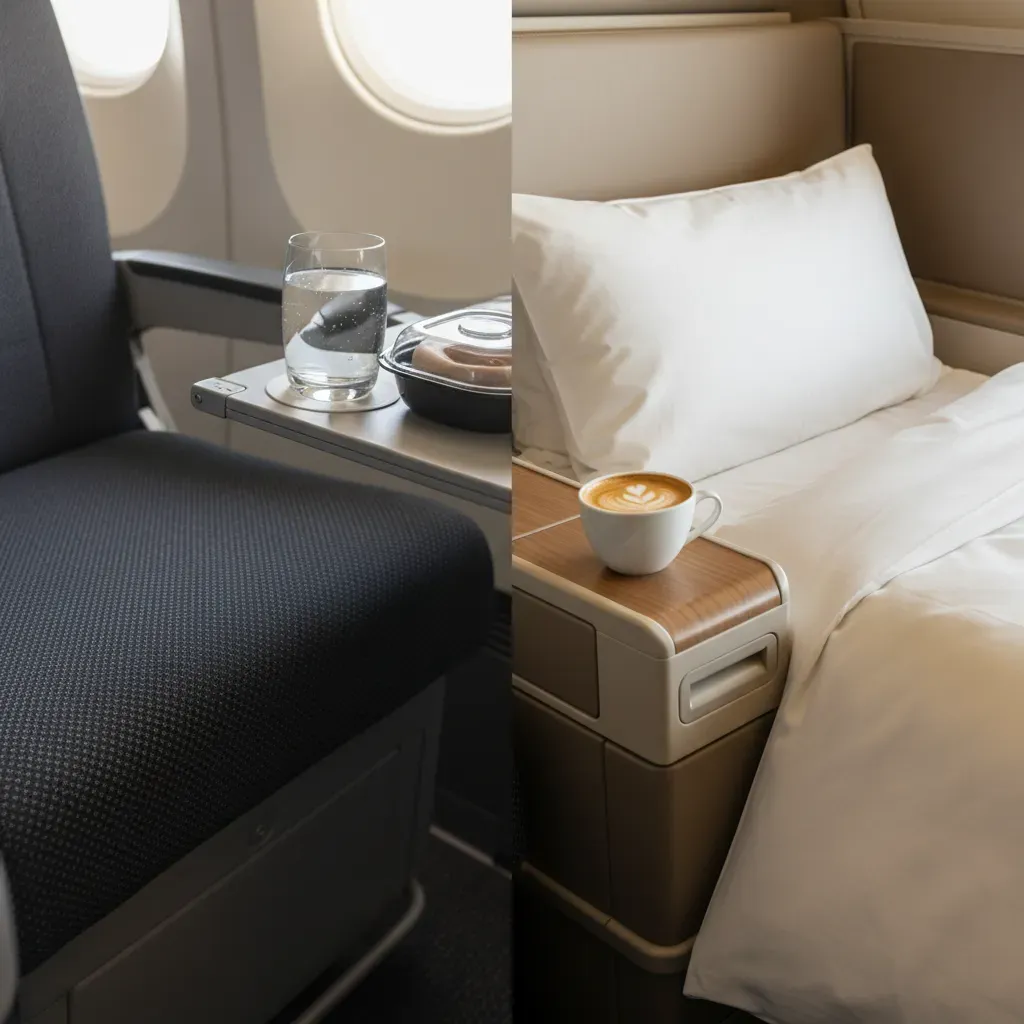
Qantas A380 Premium Economy typically appeals to travelers who want more personal space, a calmer cabin, and improved dining without moving into the fully lie-flat category. Qantas Business Class, by contrast, is designed for travelers who place a higher premium on privacy, sleep quality, lounge access, and a more complete end-to-end premium airport experience.
For many discerning travelers, the central question is not whether Qantas is reputable. It generally is. The more useful question is whether the A380 Premium Economy cabin is enough for your route, schedule, and reason for travel. If you are also comparing across carriers, our perspective on the best premium economy options may help frame where Qantas sits within the wider market.
Refurbishment Status and Aircraft Variability (What to Confirm Before You Book)
Here is the thing: “Qantas A380 Premium Economy” is a label, not a guarantee of a single, uniform experience. In practice, the feel of the cabin can vary meaningfully by aircraft tail number, refurbishment status, and even the route assignment at the time you travel. That variation can influence everything from seat condition and cabin finishes to the details that shape perceived polish on a long overnight sector.
What many travelers overlook is that aircraft assignments may change, sometimes close to departure, for operational reasons. In most cases, your ticket will still reflect Premium Economy, but the exact seat product, cabin ambience, and even the seat map you selected from can change if equipment is swapped. For a route as long as the United States to Australia, this is not an academic concern. Small differences in seat placement, traffic flow, and cabin wear can have an outsized impact on rest.
From a practical standpoint, there are several sensible checks to make before ticketing. You may wish to confirm that your flight is scheduled as an A380 and not a different long-haul aircraft type on the same city pair. You may also want to review the seat map displayed for your specific flight and compare it with current cabin photos, keeping in mind that seat maps and published images are not always updated in real time. If you are working with a professional advisor, it is reasonable to ask what is currently operating on that route, whether the pattern has been stable, and whether there are any known cabin differences that could affect your comfort on the date you plan to travel.
The reality is that equipment changes can never be eliminated entirely, even with careful planning. Risk can be managed, however. For high-stakes trips, it may be prudent to choose flights with more consistent aircraft patterns where possible, and to build an arrival-day buffer if you have important commitments shortly after landing. Setting expectations correctly is part of premium travel planning, particularly on ultra-long-haul routes where a small shift in onboard comfort can influence the first day of your itinerary.
Cabin Experience Details
Qantas A380 Premium Economy
On the A380, Premium Economy usually benefits from being physically distinct from the main Economy cabin, which can create a noticeably quieter atmosphere. That separation matters on overnight services, where reduced foot traffic and a more restrained cabin environment often improve the perception of comfort.
The seat itself is typically the main reason travelers consider this cabin. You can expect materially more width and recline than Economy, along with a more supportive shell-style seat design, leg rest features on many aircraft, and improved dining presentation. For travelers who do not require a flat bed but strongly value personal space, this can be a practical middle ground.
Service in Qantas Premium Economy is usually more attentive than in the main cabin, though it still operates within a higher-density environment than Business Class. Meal service tends to be upgraded in both presentation and pacing, and amenity touches may feel more thoughtful. Even so, this remains a recliner-style experience, not a true sleep-focused cabin.
Qantas Business Class on the A380
Qantas Business Class on the A380 is a much stronger proposition for travelers who arrive with meetings, onward connections, or significant plans on arrival. A lie-flat bed changes the flight from endurance to recovery. Depending on the exact aircraft configuration and route, travelers may find the seat highly competitive in terms of bed length, storage, direct aisle access, and overall privacy, though not always the most contemporary product in the global market.
Business Class also changes the airport portion of the journey. Priority check-in, expedited boarding in many cases, lounge eligibility, and improved flexibility all contribute to the value equation. On a trip to Australia, where flight times are substantial, those pre-departure and connection advantages are not minor details. They can affect how composed you feel before the longest segment even begins.
Dining, wine selection, and crew interaction in Qantas Business Class are typically more polished than in Premium Economy, although consistency may vary by route, crew, and load factor. In most cases, the strongest reason to book it is still sleep quality rather than catering alone.
Qantas A380 Premium Economy Seat Map, Best Seats, and Cabin Layout Notes
For discerning travelers, seat selection in Premium Economy is not a minor detail. On an A380, where the cabin footprint is large and service areas can create natural gathering points, choosing the right row can materially affect sleep quality and overall calm. Cabin layouts are subject to change by aircraft and refurbishment status, but Qantas A380 Premium Economy is commonly arranged in a 2-3-2 configuration. That structure shapes both privacy and traffic flow in ways that are worth considering before you commit to a specific seat.
In most cases, the main comfort variables come down to proximity to galleys and lavatories, and your position relative to the cabin’s natural walkways. Seats near these areas may experience more light, noise, and foot traffic, particularly during meal services and in the hours when travelers move around to stretch. Even in a well-managed cabin, the rhythm of a very long flight means there will be activity. Your goal in Premium Economy is to place yourself where that activity is least likely to interrupt rest.
Now, when it comes to “best seats,” the logic is typically more useful than any single row number. Bulkhead seats can be appealing because they may offer a greater sense of space in front, and for some travelers they can feel less confined during an extended sector. The trade-off is that bulkhead rows are often closer to galleys or lavatories, and fixed armrests can affect how open the seat feels. Families may also be seated nearby depending on bassinets and airline policy, which can change the sound profile in that area. If you are very sensitive to disturbance, it is often wiser to prioritize a quieter zone over a small gain in perceived space.
For couples, the window pairs in a 2-3-2 cabin are typically the most natural choice for a more contained experience. You gain a sense of privacy and can minimize exposure to passing traffic. The compromise is aisle access. In Premium Economy, you typically do not have direct aisle access from every seat, so you may want to decide whether uninterrupted rest or ease of movement matters more for your personal travel style.
For travelers who value flexibility, aisle seats can be the more comfortable choice over the course of a long flight, particularly if you prefer to stand, stretch, and move on your own schedule. The trade-off is greater exposure to foot traffic, service carts, and incidental contact. The center section of the cabin can work well for companions traveling together, and it may be especially practical for a party of three. For two travelers who prefer a quieter, more self-contained experience, the window pair is usually the more refined choice in this cabin style.
Think of it this way: Premium Economy is at its best when it feels controlled and predictable. If sleep is a priority, you typically want to reduce the chances of interruption by choosing seats away from high-traffic rows, prioritizing a stable, quieter portion of the cabin where lighting and movement tend to be less frequent. If you know you are unusually sensitive to cabin activity, or if you have important commitments shortly after arrival, there is a point where Business Class becomes the more rational choice. The advantage is not status. It is the ability to lie flat, close yourself off more effectively, and reduce the impact of cabin rhythms on your rest.
Pricing Context and Value
Flight pricing for premium cabins is highly variable, especially on Australia routes, and travelers should avoid making decisions based on outdated published fares. Flight Experts currently offers Business Class Flight Booking for routes including the US to Australia, with a verified pricing context of $2,000 – $8,000+, depending on route and airline. The service includes a personal travel consultant, seat selection, meal preferences, check-in assistance, price drop monitoring, and cabin upgrade alerts.
For travelers considering a more comfortable alternative to Economy without moving fully into Business Class, Flight Experts also offers Premium Economy Flight Booking with verified pricing context of $800 – $3,000 on long-haul international routes, subject to route and availability.
That pricing context is useful because value in premium travel should be measured against trip purpose. Premium Economy may represent sensible value for leisure travelers who prioritize comfort and cabin calm but can tolerate sleeping in a recliner seat. Business Class may justify the higher investment if uninterrupted sleep, airport privileges, schedule resilience, and arrival readiness are central to the trip.
Pros and Cons
Strengths
- Qantas A380 Premium Economy typically offers a quieter, more exclusive cabin feel than the main Economy section, which may be especially valuable on overnight flights.
- The Premium Economy seat usually provides meaningful additional width, recline, and leg support, making very long sectors more manageable for travelers who do not require a flat bed.
- Qantas Business Class offers lie-flat comfort, which is often the single most important differentiator for Australia-bound journeys.
- Business Class travelers generally benefit from lounge access, priority airport handling, and a more refined pre-flight experience.
- The A380 itself is often favored by premium travelers for its quieter ride characteristics and more spacious cabin environment compared with some smaller long-haul aircraft.
- Qantas remains a familiar and trusted premium carrier for many North America to Australia itineraries, which may add reassurance for complex long-haul travel planning.
Considerations
- Premium Economy, even when well executed, is still a recliner-style product and may not provide meaningful sleep quality for every traveler on ultra-long flights.
- Qantas Business Class can be very appealing, but depending on aircraft refurbishment status and route, some global competitors may feel more current in seat privacy or suite design.
- Service consistency may vary, as it often does across long-haul airlines, depending on crew style, catering uplift point, and cabin load.
- The best choice depends heavily on timing, purpose of travel, and onward plans on arrival, so the higher cabin is not automatically the better fit for every itinerary.
Who It Suits
Qantas A380 Premium Economy is often best for leisure travelers, couples, and experienced long-haul passengers who want a significantly more comfortable journey than Economy but do not necessarily need full lie-flat sleep. It can also suit travelers who prefer allocating more of their travel investment to hotels or ground experiences while still maintaining a refined in-flight standard.
Qantas Business Class is better suited to travelers with demanding schedules, milestone trips, premium onward arrangements, or a strong preference for privacy and genuine rest. If you are traveling for a honeymoon, important family occasion, executive schedule, or a multi-stop Australia itinerary, Business Class may be the more appropriate match.
Flight Experts Recommendation
From a luxury travel advisory perspective, Qantas A380 Premium Economy is a credible choice for travelers who value comfort and cabin atmosphere but can accept the limitations of a non-flat seat. Qantas Business Class is the stronger recommendation for travelers who want the journey to feel restorative rather than simply tolerable.
Flight Experts specializes in Business Class Flight Booking, Premium Economy Flight Booking, and more tailored routing support through Complex Itinerary Planning. Led by Mike Chirilenco, the service is designed for travelers who prefer a personal consultant rather than a self-service platform. If you are weighing Qantas against other carriers, need help securing the most suitable cabin, or want a more carefully structured Australia itinerary, speaking with Flight Experts is a sensible next step.

How to Choose Between Qantas Premium Economy and Business Class
The right cabin choice usually depends on five practical criteria rather than airline branding alone.
1. Flight timing and sleep requirement
If your Qantas flight is primarily overnight and you need to function well shortly after landing, Business Class usually has a clear advantage. A lie-flat seat is often the deciding factor on transpacific services. If your schedule is more flexible and a lighter first day in Australia is acceptable, Premium Economy may be entirely sufficient.
2. Purpose of travel
A honeymoon, anniversary, or major family journey may justify the enhanced privacy and service of Business Class. A more relaxed leisure trip could make Premium Economy the more balanced choice. The emotional purpose of the trip matters, particularly for milestone travel where the flight itself is part of the experience.
3. Your tolerance for recliner-style seating
Some travelers sleep reasonably well in Premium Economy. Others do not, regardless of seat quality. If you already know that you struggle to sleep upright, Premium Economy may feel like a compromise too far on a route to Australia.
4. Airport experience priorities
For many discerning travelers, lounge access, smoother ground handling, and priority services are part of the premium standard, not an extra. If those elements matter to you, Business Class often provides a more complete door-to-gate experience. You may also wish to review broader premium cabin considerations through the Airline Business & First Class Reviews category and the Premium Cabin Experience & Amenities category.
5. Itinerary complexity
If your Qantas flight is only one segment within a more complex international journey, cabin choice should be assessed in context. Mixed-cabin itineraries, alliance combinations, and stopover structures can change what represents true value. In these cases, professional planning is often more useful than comparing isolated sectors online.
Lounge Access and Ground Experience: Premium Economy vs Business Class on Qantas
What sets this apart on US to Australia itineraries is how much the ground experience can shape fatigue management. The flight is long, the time zones are unforgiving, and pre-departure comfort is not simply a pleasant extra. It can influence how you board, how you settle, and how well you manage rest once the cabin lights go down.
In most cases, Qantas Business Class is the cabin that aligns with lounge access as a built-in part of the product, subject to fare rules, lounge policy, and operational constraints. Premium Economy, by contrast, typically does not include lounge access by default, although outcomes can change depending on elite status, the specific ticket conditions, and partner or alliance eligibility. If lounge time is central to your definition of premium, it is worth verifying access terms for your exact itinerary rather than assuming that Premium Economy will include it.
Consider this: the airport journey is not one single moment, it is a chain of moments that compound. Priority check-in and more structured boarding, where offered, can reduce time in crowded queues and lower the feeling of friction before departure. A lounge environment can provide quieter space to dine, work, or rest, which may be especially valuable if you are connecting onto the long transpacific segment. On the return journey, lounge access can also matter if you are managing a tight connection window or trying to decompress between flights.
From a practical standpoint, the decision lens can be simple. If your priority is the seat itself and you can tolerate a more conventional terminal experience, Premium Economy may deliver the comfort you need onboard. If you define premium as an end-to-end standard, meaning quieter pre-departure space, more controlled airport handling, and a stronger foundation for rest on an overnight sector, Business Class tends to align better in most cases. On ultra-long routes, the difference is not only about what happens at 35,000 feet. It is about how consistently the entire journey supports your energy and composure.
Frequently Asked Questions
Is Qantas A380 Premium Economy worth it for flights to Australia?
For many travelers, yes. It typically offers substantially more comfort, cabin calm, and dining quality than Economy. Its value is strongest for leisure travelers who want a refined long-haul experience but do not need a lie-flat bed. For travelers who place a premium on sleep quality, Business Class may still be the better fit.
How does Qantas Premium Economy compare with Qantas Business Class?
The primary difference is sleep and privacy. Premium Economy generally improves seat space, service, and atmosphere, but it remains a seated experience. Business Class usually adds lie-flat comfort, lounge access, and a more elevated airport-to-arrival journey. On ultra-long flights, that distinction can be significant depending on your schedule and travel goals.
Is the Qantas A380 a good aircraft for premium travel?
In many cases, yes. The A380 is often appreciated for its quieter cabin environment and spacious feel. Those qualities may enhance both Premium Economy and Business Class. That said, the onboard experience still depends on the specific seat design, route, and service consistency, not only the aircraft type itself.
Does Qantas Business Class feel competitive today?
It generally remains a strong long-haul product, especially for travelers prioritizing reliable lie-flat comfort and access to a full premium airport experience. Some travelers may find that certain international carriers offer newer suite concepts or more privacy on specific routes, so comparisons should be made cabin by cabin rather than by brand alone.
Who should choose Premium Economy instead of Business Class?
Premium Economy is usually best for travelers who want more comfort than Economy, appreciate a smaller and calmer cabin, and do not require full-flat sleep. It often suits leisure itineraries with flexible arrival plans, where the goal is to improve the journey materially without making every decision around maximum privacy.
Who should choose Qantas Business Class?
Business Class is typically best for travelers who need to arrive rested, value lounge access and airport efficiency, or are celebrating a milestone trip where the journey should feel fully premium. It may also be the better choice for multi-segment itineraries where fatigue management is an important part of overall trip quality.
What are the best seats on the Qantas A380 Premium Economy cabin?
The best seats are typically those that reduce cabin disturbance and match your travel style. In many cases, seats away from galleys and lavatories are preferable because they may experience less light, noise, and foot traffic. Bulkhead seats can feel more spacious for some travelers, but they may also sit closer to service areas and have trade-offs such as fixed armrests. Couples often prefer the window pairs in a 2-3-2 cabin for a more contained experience, while aisle seats can be more practical if you value easy movement during a long flight. Seat maps and layouts are subject to change by aircraft, so verifying the exact configuration for your flight is important.
Is Premium Economy worth it on Qantas?
For many experienced travelers, it can be. Qantas Premium Economy typically offers a quieter cabin, more personal space, and an improved dining experience compared with Economy, which can be meaningful on long-haul sectors. Its limitations are equally important: it remains a recliner-style seat, and sleep quality may not be sufficient for every traveler on an overnight transpacific route. If rest is central to your arrival-day plans, Business Class may align better with your needs.
Which Qantas A380 aircraft have been refurbished?
Refurbishment status can change over time, and it is not always practical to rely on a static list when planning a specific departure date. The more reliable approach is to confirm the aircraft scheduled for your flight and review the current seat map and cabin indicators for that exact service, keeping in mind that aircraft assignments may change. A professional advisor can often help you interpret what the currently scheduled configuration suggests about the onboard product you can reasonably expect.
What do you get in Qantas Premium Economy on the A380?
You can typically expect a separate Premium Economy cabin environment, a wider and more supportive seat than Economy with greater recline, and upgraded meal presentation and service pacing. Service is usually more attentive than the main cabin, though still within a higher-density setting than Business Class. Specific inclusions and cabin details can vary by aircraft and route, so it is sensible to verify the current configuration for your exact flight.
Can Flight Experts help book Qantas premium cabins?
Yes. Flight Experts offers Business Class Flight Booking and Premium Economy Flight Booking, with a personal consultant assigned to present options, usually within 30 minutes. Services may include seat selection, meal preference coordination, check-in assistance, and support tailored to your route and travel priorities, subject to airline availability.
Can Flight Experts help with a more complex Australia trip?
Yes. For travelers combining Australia with other destinations, open-jaw routing, stopovers, or alliance-based itineraries, Flight Experts also offers Complex Itinerary Planning. This may be especially useful if you are balancing cabin class decisions across multiple sectors and want the journey designed cohesively rather than booked one segment at a time.
Key Takeaways
- Qantas A380 Premium Economy is often a strong option for travelers who want space, quieter cabin conditions, and improved service without moving into lie-flat travel.
- Qantas Business Class is typically the better choice for sleep quality, privacy, lounge access, and arrival readiness on long flights to Australia.
- The A380 generally enhances the premium experience through a calmer and more spacious onboard environment.
- The right choice depends on route timing, trip purpose, sleep needs, and overall itinerary complexity.
- Flight Experts can help evaluate whether Qantas Premium Economy or Business Class best aligns with your travel priorities.
Conclusion
Qantas A380 Premium Economy is a thoughtful premium cabin that may suit travelers seeking comfort, calm, and a more polished long-haul experience than Economy provides. Qantas Business Class, however, remains the stronger option for travelers who value true rest, elevated airport handling, and a more complete premium journey. The better choice is rarely about prestige alone. It is about matching the cabin to your route, purpose, and expectations. To begin planning your Australia itinerary with more personalized guidance, speak with Mike Chirilenco or the Flight Experts team. Their concierge-style approach can help you compare cabins, airlines, and routing options with the level of care high-value travel deserves.



