
Business Class From New York (JFK): Best Routes

Why New York Is a Distinct Market for Business Class Flights from New York
Most U.S. origin cities are judged by access. New York is judged by discernment. Here, the question is rarely whether premium long-haul service exists. Instead, the question is which nonstop is genuinely worth booking.
JFK and Newark each serve different premium patterns. JFK generally offers broader international carrier variety, especially on transatlantic and selective Middle East routes. Newark often matters more to travelers who prefer United’s long-haul network and its Polaris ecosystem. In practice, the best business class flights from New York may depend on alliance preference, terminal rhythm, and lounge practicality as much as destination.
This distinction matters because Business Class quality is not uniform across a city as large as New York. A route to London may look interchangeable on paper. In reality, the experience can vary in seat privacy, direct aisle access, bedding quality, departure timing, chauffeur coordination on the ground, and lounge standards. Industry sources such as airline alliance cabin standards, IATA operating guidance, and long-haul fleet deployment patterns support the same conclusion. The operating aircraft and airport context usually matter more than the headline destination.
For readers comparing coasts, the contrast with flights from LA or flights from SF is useful. New York often gives you denser premium competition to Europe and selected global capitals. However, it may also require more care in airport and carrier selection because the spread in product quality is wider.
The Strongest Nonstop Route Groups for Business Class Flights from JFK and EWR
Transatlantic nonstops are usually the first place to start. New York supports a deep range of Business Class service to London, Paris, Frankfurt, Zurich, Milan, Madrid, Rome, and other major European cities. These routes often attract flagship aircraft and stronger premium competition because they serve both corporate and luxury leisure demand. Overnight eastbound sectors make seat design especially important. A fully flat bed with strong privacy and direct aisle access is usually more valuable here than elaborate soft product alone.
Middle East nonstops may offer some of the most polished premium experiences available from the New York market. Carriers such as Emirates and Qatar Airways are often central to this conversation depending on schedule and airport. On these longer sectors, bedding, dining cadence, lounge quality, and crew consistency often shape the difference between a merely comfortable flight and one that feels restorative on arrival.
Select transpacific and Asia-bound itineraries can also be compelling, though the nonstop picture is narrower and more aircraft-sensitive. On these missions, a refined Business Class seat matters even more. Travelers are usually balancing sleep, productivity, and arrival readiness over a far longer duty cycle.
Domestic premium transcon service also deserves mention. While this article focuses on long-haul premium travel, some New York departures within the U.S. may feature elevated Business Class products that are materially stronger than conventional domestic recliner service. As a result, they can be sensible positioning choices before an onward international itinerary, subject to schedule and ticketing structure.
Route Strategy for Business Class Flights from New York Beyond “Nonstop vs One-Stop”

The nonstop is often the cleanest expression of premium travel, especially from New York. However, a one-stop itinerary can outperform a nonstop in the areas that matter most. These often include sleep timing, lounge quality, and aircraft consistency. This is most common on Asia-bound travel, where the nonstop option may be limited. It may also operate at less favorable times for rest or rotate aircraft types across seasons.
If a one-stop routing gives you a more predictable overnight segment on an aircraft with a consistently strong seat, the journey may feel more controlled. An elevated lounge at a major hub can strengthen that advantage. In many cases, the real benefit comes from placing your longest sleep window on the better aircraft. Then you can use the connection point to reset, dine quietly, and board the second segment without feeling rushed.
How airport choice shapes the itinerary
From a practical standpoint, positioning is also part of the New York premium conversation. Within the New York area, the JFK versus EWR decision is not only about geography. It can also be about terminal rhythm, lounge access, and which airport offers the more reliable version of a carrier’s Business Class on your route.
For some travelers, a domestic premium transcon segment used as a feeder into a long-haul departure may create a cleaner itinerary. It may work better than forcing a single airport choice that does not align with the strongest long-haul cabin. This is especially true when the trip carries high expectations and the traveler values predictability over novelty.
Travelers also overlook niche operating models that appear from time to time, including all-business-class concepts on selected city pairs. These can be compelling when the onboard product, schedule, and ground experience align well. At the same time, operating models, routes, and onboard standards can change. Therefore, it is wise to confirm the exact aircraft, cabin, and service pattern before treating any option as a dependable premium category.
JFK and EWR Carrier Product Comparison
The most useful way to compare New York premium options is to match each airport to carrier strength.
JFK often appeals to travelers who want broader international carrier choice. This is where you may find especially competitive premium products across Europe and the Middle East, along with a wider spread of alliance options. Depending on the route, JFK can be the stronger airport for travelers who prioritize a specific foreign carrier cabin, elevated lounge access, or a more curated onboard style.
EWR is often more attractive for travelers who value network coherence through one airline family, particularly on United-operated long-haul service. United Polaris has improved the consistency of long-haul Business Class expectations, especially where the route uses an aircraft built around direct aisle access and a purpose-built premium seat. For some clients, that continuity across booking, lounge access, and onward connection planning matters more than variety.
Within the carrier field, several product questions should be examined on every nonstop:
- Is the aircraft scheduled with a modern, fully flat Business Class cabin?
- Does every seat offer direct aisle access, or are some seats less private?
- How credible is the lounge experience at the departure terminal?
- Does the departure time support sleep on an overnight route?
- How dependable is the airline’s premium service consistency on that city pair?
An airline’s reputation alone is not enough. Premium travelers are usually best served by reviewing the specific aircraft, seat map, and route-level experience rather than assuming a citywide standard. That is especially true in New York, where network breadth can hide meaningful product differences.
Best Business Class Flights from New York: How to Judge Quality
“Best Business Class” from New York is rarely a single-airline answer. It is usually a route and product answer. Business class flights from New York give travelers access to excellent carriers, yet the decisive variable is often the aircraft operating the flight and the cabin configured on that day. Published schedules and cabin configurations can change. Sometimes they change seasonally, and sometimes for operational reasons. Therefore, it is wise to judge quality with a framework that still works when aircraft assignments move.
Start with aircraft type and seat architecture
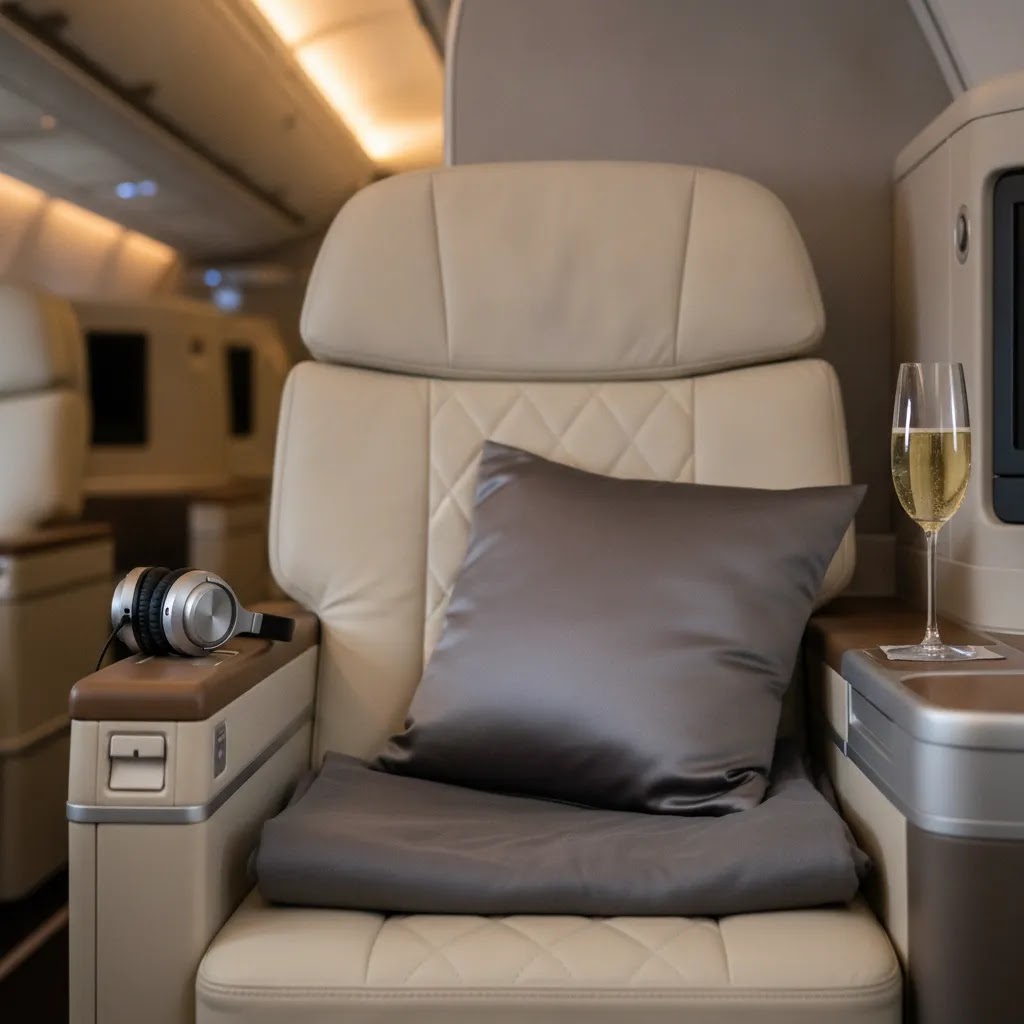
Start with aircraft type and seat architecture. In most cases, a modern long-haul cabin is designed around direct aisle access for every passenger. Seat architecture matters because it shapes privacy, sleep quality, and workspace comfort. Reverse herringbone layouts often provide a strong blend of privacy and openness. Staggered configurations can also be excellent, but some create uneven “good” and “less good” seats within the same cabin. Older 2-2-2 designs can still be comfortable. However, they often require some passengers to step over a neighbor. For discerning travelers, that difference is not theoretical. It can shape the entire overnight experience.
Focus on sleep and usability, not one headline feature
Door or no door is a secondary question, not the first one. A suite door can add meaningful privacy, especially for travelers who work onboard or want to protect sleep. At the same time, a well-designed open seat with strong shell structure and smart spacing can be more comfortable than a door-focused concept with a tighter footwell or weaker sleeping ergonomics. In practice, the best product is the one that delivers sleep, privacy, and usability together.
Read the seat map like an advisor, not like a marketer. When evaluating business class flights from New York, confirm that every seat has direct aisle access. Also watch for layouts where some seats are clearly weaker. If passengers must climb over another traveler to reach the aisle, the product is meaningfully weaker on an overnight route. Bulkhead seats may offer extra space in some cabins. However, they can also sit closer to galleys and lavatories, which increases light and foot traffic. Mid-cabin seats often feel more stable for sleep. By comparison, the last rows may see more movement depending on the service flow.
Couples should select with intention. Many modern cabins alternate between paired center seats and more separated arrangements. If you prefer conversation, paired center seats can be ideal. If you prefer privacy and independent sleep, two aisle seats may be the better choice even when traveling together. This small decision can have an outsized effect, especially on overnight transatlantic departures.
Align the product to the purpose of the trip. An overnight to Europe usually rewards a seat that supports rapid sleep, quiet lighting, and minimal interruptions. Longer Middle East or Asia missions place more weight on sustained comfort, storage, workspace practicality, and crew pacing. In addition, consistency by route is a serious factor. Some airlines operate a clear flagship product on certain city pairs and a more mixed experience on others. Validating the actual operating aircraft, and recognizing that it could change, is often the difference between a good premium trip and a truly well-chosen one.
Pros and Cons
Strengths
- New York offers one of the broadest nonstop Business Class departure pools in the United States, especially to Europe.
- JFK and EWR create genuine choice across alliances, foreign carriers, and service styles rather than forcing a single-hub compromise.
- Premium travelers may find stronger route-level competition here, which often encourages better aircraft deployment and more polished cabin products.
- Nonstop availability to major business and leisure capitals can reduce the fatigue and uncertainty associated with intermediate connections.
- The market is well suited to travelers who care about matching route purpose to product quality, such as overnight rest, meeting-ready arrival, or celebratory travel.
Considerations
- Product variation is significant, so not every Business Class seat from New York delivers the same level of privacy or comfort.
- Airport choice can materially affect the journey, including terminal flow, lounge access, and ground transfer timing.
- Popular nonstop routes may see high demand during holiday periods, fashion weeks, major conferences, and peak summer travel windows.
- Some itineraries that look attractive by destination may still be weaker in practice if the aircraft or cabin configuration is dated.
Cabin Hygiene for Business Class Flights from New York
Cleanliness is part of the premium experience, but expectations can become unrealistic. The reality is that aircraft utilization is high on many New York routes. What happens between flights depends heavily on ground time and the station’s operating rhythm. A quick turnaround usually focuses on visible reset items. These include collecting service ware, removing obvious waste, restocking, and preparing the cabin for boarding. A longer ground time may allow for deeper cleaning. Even then, results can vary by airport, staffing, and operational pressure.
For discerning travelers, the most useful approach is to understand what a premium cabin can reasonably deliver on a high-utilization route. Seat surfaces may not feel freshly detailed on every departure, especially on flights that arrive and depart close together. That does not necessarily indicate neglect. More often, it reflects timing. If cabin hygiene is a priority, choosing a flight that is likely to originate in New York rather than arrive and turn quickly may improve the odds of a more fully refreshed cabin. However, this can never be assumed without current operational context.
What to check before boarding
You can also read cleanliness signals without becoming overly cautious. Bedding presentation is often the clearest indicator in Business Class because it reflects both provisioning discipline and cabin reset standards. Lavatory condition during boarding is another useful sign. So is the visible state of tray tables and common touch points. Galley discipline matters as well, since a well-managed galley often correlates with a calmer cabin and a more consistent service sequence. None of these signals are guaranteed across carriers or stations. Similarly, premium cabins can vary within the same airline depending on the route and the day.
What sets this apart for New York travelers is choice. If two comparable options exist, a quieter cabin location can improve perceived cleanliness and comfort because it reduces traffic and incidental contact. Choosing seats away from galleys and lavatories may also help. Ultimately, Business Class is designed to feel elevated, but it is still a commercial environment. The best outcomes come from selecting the right product and setting expectations that are premium, yet grounded in operational reality.
Who Business Class Flights from New York Suit Best
Business class flights from New York are usually best suited to travelers who value precision over convenience labels. That includes executives who need to arrive functional after an overnight crossing. It also includes couples planning milestone travel who care about the full premium sequence from lounge to landing, as well as families or private travelers who want nonstop simplicity where available.
They may also suit clients coordinating larger itineraries. A New York departure can serve as the strongest opening segment for a multi-city Europe or Middle East journey, provided the outbound flight is selected with attention to aircraft type, sleep quality, and onward timing. Travelers who simply want any Business Class seat may underuse the strength of this market. By contrast, travelers who want the right premium fit can benefit substantially from professional curation.
Flight Experts Recommendation

For New York departures, Flight Experts generally recommends evaluating the itinerary as a complete premium chain rather than a seat in isolation. That means balancing airport access, nonstop logic, aircraft type, lounge quality, and arrival timing against the purpose of the trip. On overnight Europe departures, the strongest choice is often the flight that best supports actual rest. On longer routes to the Gulf or onward Asia-bound travel, cabin consistency and ground coordination may become more important.
Flight Experts offers Business Class Flight Booking for major global carriers and routes including the U.S. to Europe, Asia, the Middle East, Australia, and domestic U.S. sectors. The service includes a personal travel consultant, seat selection guidance, meal preference support, check-in assistance, and cabin upgrade alerts, with options usually presented within 30 minutes. For complex journeys, Complex Itinerary Planning may be especially valuable. If you would like a tailored recommendation, contact Mike Chirilenco and the Flight Experts team to discuss your preferred departure airport, travel style, and destination priorities.
How to Choose the Right Business Class Flights from New York
1. Start with the airport, not the airline advertisement.
JFK and Newark can produce very different experiences before you ever board. Chauffeured arrival timing, terminal congestion, check-in flow, and lounge design all influence how composed the journey feels. For some travelers, the most suitable option may be the airport that aligns better with home base or car service logistics. For others, the superior cabin product may justify the longer ground transfer.
Verify the aircraft before you book
2. Verify the aircraft and seat map.
This is one of the most important screening steps. Business class flights from New York may range from highly private suites to older staggered layouts that are still fully flat but less refined. On overnight sectors, direct aisle access and credible sleep ergonomics usually deserve priority.
Match the cabin to the trip purpose
3. Match the route length to the service style.
A short overnight to Western Europe places a premium on efficient dining, prompt lights-down timing, and a bed that supports several hours of meaningful rest. A longer flight to the Middle East may reward carriers with stronger soft product, more attentive crew pacing, and lounge standards that help frame the trip well before departure.
4. Look beyond the outbound seat.
Premium travelers often focus heavily on the first long-haul segment. However, return timing, lounge reciprocity, and alliance continuity may matter just as much. If the itinerary includes onward sectors, mixed terminals, or separate tickets, professional review becomes even more valuable.
5. Use an advisor when the trip has high expectations attached to it.
Milestone travel, complex multi-city journeys, and high-value premium bookings benefit from individual oversight. Flight Experts specializes in premium air travel with current service options in Business Class, First Class, Premium Economy, and more advanced multi-city planning. The team’s role is not simply to locate a seat. Rather, it is to align the route with your expectations for privacy, comfort, and reliability.
Frequently Asked Questions
Is JFK always better than Newark for Business Class?
No. JFK often offers wider international carrier variety, while Newark may be more compelling for travelers who prefer United’s long-haul network and a more unified airline ecosystem. The better choice usually depends on your route, preferred carrier, alliance priorities, and how much value you place on airport access and terminal flow.
Which nonstop routes from New York are usually strongest in Business Class?
Transatlantic routes are typically the deepest premium category, especially to major European capitals. Selected Middle East nonstops may also offer excellent Business Class experiences. The strongest option is not defined by geography alone. It usually depends on the aircraft, seat design, overnight timing, and how reliable the carrier’s premium execution is on that specific route.
Are all Business Class seats from New York fully flat?
Many long-haul premium routes from JFK and EWR do feature fully flat seats, but not every marketed Business Class cabin is equal in privacy or layout. Some products may feel significantly more current than others. Checking the exact aircraft and cabin map before booking is typically essential, especially for overnight service.
Does lounge access differ meaningfully between airlines in New York?
Yes. Lounge quality may vary substantially by airline, terminal, and alliance arrangement. Some lounges are designed as part of a flagship premium sequence, while others are more functional than memorable. Travelers who value preflight dining, quieter seating, or premium shower facilities should assess lounge access as part of the booking decision.
Are nonstop flights always the best choice from New York?
Not always, though they are often attractive. A nonstop can reduce friction, but a one-stop itinerary may still be preferable if it offers a materially better seat, stronger timing, or a more restful overnight structure. This depends on destination, aircraft deployment, and the purpose of the trip.
What should business travelers prioritize on an overnight JFK departure?
Most should prioritize a modern lie-flat seat, direct aisle access, efficient boarding, and a schedule that supports prompt sleep. Lounge dining may also matter if you prefer to maximize rest onboard rather than dine after takeoff. Travelers arriving for meetings usually benefit from evaluating the flight around functional arrival, not brand image alone.
Can Flight Experts help with more than a single Business Class ticket?
Yes. Flight Experts provides Business Class Flight Booking, First Class Flight Booking, Premium Economy Flight Booking, Group & Corporate Travel, and Complex Itinerary Planning. That may be especially useful if your New York departure is part of a larger international journey or if you want a single advisor to manage the premium air strategy.
How quickly can Flight Experts present options?
For Business Class Flight Booking, options are usually presented within 30 minutes after you submit a request, according to current service information. More complex itineraries may require additional planning time depending on routing, carrier combinations, and trip structure.
What is the best airline to fly business class?
The best choice is typically the airline and aircraft combination that delivers a modern lie-flat seat with direct aisle access, a dependable lounge plan at your departure airport, and timing that supports the purpose of your trip. From New York, this is often route-specific. The same airline can feel markedly different depending on whether you are booked on its newest long-haul cabin or an older configuration. Reviewing the operating aircraft and seat map usually produces a more reliable answer than brand reputation alone.
Which airline should I avoid for business class?
It is generally wiser to avoid a specific dated configuration rather than avoid an airline outright. In most cases, the weaker experiences are tied to routes where the aircraft is scheduled with older cabins, limited privacy, or layouts that do not offer direct aisle access for every seat. Since fleet assignments can change, the more dependable strategy is to verify the operating aircraft and seat map and choose the flight that aligns with your expectations for sleep, privacy, and cabin consistency.
Do airlines clean seats between flights?
Typically, a quick turnaround includes a cabin reset rather than a deep clean. That usually means collecting waste, refreshing visible areas, and preparing the cabin for boarding, while a longer ground time may allow for more thorough cleaning. Results can vary by route, airport, and operational conditions. If cleanliness is a priority, reviewing the flight’s operating pattern and choosing seats away from high-traffic areas may help, though it is never a guarantee.
Is it worth the money to fly business class?
For many experienced travelers, Business Class is worth it when the trip outcome matters, such as arriving rested for meetings, protecting sleep on an overnight crossing, or keeping a milestone journey calm and well-paced. The value is usually highest when you select a true long-haul seat designed for sleep, pair it with credible lounge access, and choose timing that supports rest. If the product is dated or the schedule compromises sleep, the experience may be less satisfying even if the cabin is marketed as Business Class.
Key Takeaways
- New York is best evaluated by nonstop premium route quality, not by route volume alone.
- JFK often stands out for international carrier variety, while EWR may appeal for network continuity on United-led itineraries.
- Aircraft type and seat map usually matter more than a broad airline reputation.
- Transatlantic and Middle East nonstops are often the most strategically compelling Business Class categories from New York.
- Flight Experts can help align airport choice, cabin product, and itinerary structure with your travel priorities.
Conclusion
Business class flights from New York can be exceptional, but they reward careful selection. JFK and Newark both offer meaningful strengths. However, the best outcome usually comes from matching the right airport and carrier product to the purpose of your trip. A polished overnight to Europe, a longer premium sector to the Gulf, or a more complex onward journey each calls for different decision criteria. That is where expert review becomes valuable. If you are planning business class flights from New York and want a recommendation shaped around your schedule, comfort preferences, and destination goals, speak with Mike Chirilenco or the Flight Experts team. Their personalized approach may help you move from a crowded field of options to a genuinely well-chosen itinerary.



