
Business Class Flights to India (2026 Guide)
Routes Overview: USA to India in Business Class
For business class flight tickets to India, you typically have two strategic paths: nonstop where available (fastest door to door, simplest when travel is time-sensitive), or one stop via a major hub (often better schedules, broader city coverage across India, and sometimes stronger onboard products depending on airline and aircraft).
Common India gateways include Delhi (DEL) and Mumbai (BOM), with strong onward connectivity to Bengaluru (BLR), Hyderabad (HYD), Chennai (MAA), and other major cities. If you are flying from the US, your “best” routing depends heavily on your home airport. Travelers in New York, New Jersey, Washington DC, Chicago, and the West Coast often see very different fare patterns and connection options.
One more reality: the “cost of business class flight to India” varies not only by season (summer, holiday peaks, wedding season) but also by the fare brand, change rules, and whether you are optimizing for a nonstop versus the best lie-flat seat and lounge experience.
What Matters Most on India-Bound Business Class Flights
India is a long haul market from the US. A strong business class experience is not just a lie-flat seat. It is the full chain: ground handling, lounge access, a cabin that lets you sleep, and a schedule that does not turn a 15 hour trip into 24 hours of airports.
1) Seat and sleep quality (your real “ROI”)
Prioritize a modern lie-flat seat with direct aisle access if possible. On ultra-long flights, a slightly slower itinerary with a better seat can arrive with you feeling dramatically more functional. Watch for older 2-2-2 layouts on some aircraft types and routes.
2) Connection design and minimum stress transfers
A one stop itinerary can be excellent if the hub is efficient and the layover is long enough for a shower and meal, but not so long that you lose a full day. For many travelers, the best value is a single well-timed connection with a premium lounge and predictable boarding.
3) Aircraft consistency (avoid “product roulette”)
Airlines can fly different aircraft on the same route depending on season. The business class hard product can change significantly. If a specific seat matters to you, confirm the aircraft type and seat map before you commit.
4) India arrival timing and domestic connectivity
If you are continuing to BLR, HYD, or MAA, align your international arrival with reliable domestic options. Sometimes landing in DEL for connections is easier. Sometimes BOM wins. A “better” international flight is not better if you misconnect or end up with a 7 hour domestic wait.
5) Fare rules and flexibility
For business travel and family trips with moving dates, changeability can outweigh a lower headline fare. Business class flight deals to India that look attractive may carry more restrictive change or cancellation rules depending on fare basis.
Top Route Patterns (Nonstop vs One Stop)
Option A: Nonstop USA to India (when it works, it is hard to beat)
Nonstops are ideal when you value simplicity: fewer moving parts, less exposure to missed connections, and a cleaner travel day. Nonstops can also be very competitive for travelers whose time is the highest-value currency.
The tradeoff is that nonstop availability is limited by city pair and season, and the “best business class flight in India” experience is not always on the nonstop. If sleep quality is your top priority, you may prefer a one stop itinerary on a carrier known for a top-tier hard product.
Option B: One stop via the Middle East (often the premium sweet spot)
Many travelers favor a single connection through a Middle East hub because it can combine strong lounge experiences, high service standards, and a break in the journey that helps with jet lag. It is also a common source of “best business class flights to India from USA” shortlists because multiple carriers compete aggressively on this corridor.
Option C: One stop via Europe (can be excellent, but choose carefully)
European routings can be convenient for East Coast travelers and for those who want a shorter first segment. The variability comes from aircraft type, seat generation, and the quality of the connecting hub experience. If you are traveling with tight meetings, aim for a connection that buffers typical European hub congestion.
Airline Shortlist: What Each Does Best
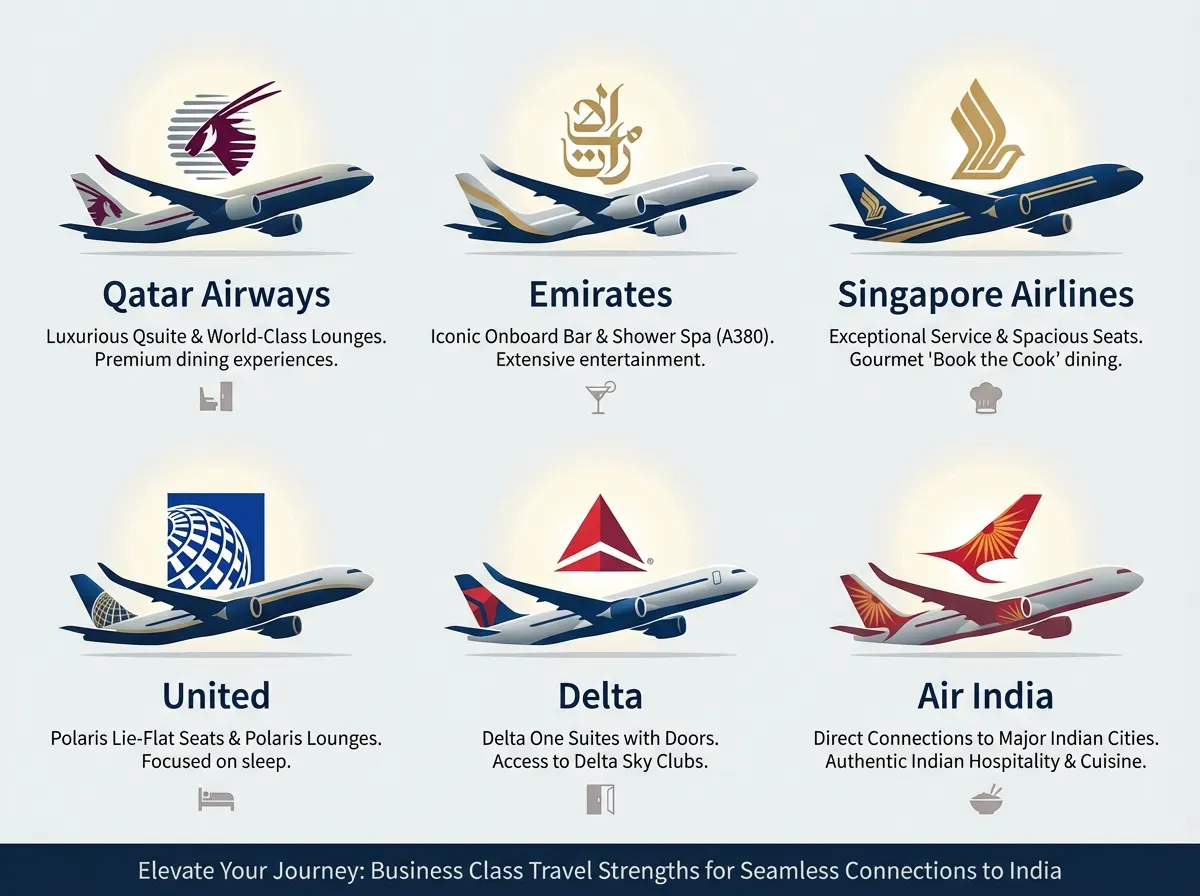
Below is a practical, buyer-focused way to think about “top business class flight to India” options. This is not about fandom. It is about matching the product to your trip.
Qatar Airways (via Doha)
Frequently chosen for a refined onboard experience and a strong overall premium journey. Great when you want a consistently elevated service and a polished hub transfer. Confirm the specific aircraft and seat type on your flights.
Emirates (via Dubai)
Often favored for lounge scale, robust network, and a premium-feeling onboard experience. Dubai can be a very workable transfer point for many US origins. Again, aircraft can matter, so verify the seat layout.
Singapore Airlines (via Singapore for select routings)
A top contender for service and comfort, but routing to India can be less direct depending on your origin and destination city. Best when you are combining Asia travel or prioritizing service consistency over shortest elapsed time.
United Polaris / Delta One / American Flagship (where available)
US carriers can be the best fit if you want to stay inside one loyalty ecosystem, simplify IRROPS handling, and maximize elite benefits. Product consistency varies by aircraft and route. For some travelers, the convenience and points earning outweigh a slightly less “boutique” service style.
Air India (nonstop-focused value and convenience)
Air India can be compelling for nonstop convenience on certain city pairs and for travelers who prioritize getting to Delhi or Mumbai with minimal complexity. As with many airlines in transition, the onboard experience can vary by aircraft and cabin configuration, so it is worth checking reviews for the specific route and plane.
Pros and Cons
Strengths
- Excellent route optionality: nonstop where available, plus strong one stop networks via major hubs.
- Real comfort gains versus economy on long-haul: lie-flat sleep, premium dining, priority services, and lounge access.
- Better trip resilience with the right connection strategy, especially when you build in a sensible buffer and choose a reliable hub.
- High upside for value when you are flexible on dates, departure airport, or connection city.
- Premium cabins make India arrivals more productive, especially for short business trips and red-eye patterns.
Considerations
- Product variability by aircraft and route is common, even within the same airline, so it is easy to overpay for an older seat.
- Peak seasons can drive sharp price swings, and the best schedules tend to sell out early.
- One stop itineraries add complexity: missed connections, long layovers, and baggage handling risk if the connection is too tight.
- Fare rules can be restrictive on some attractive-looking offers, especially if you need date flexibility.
Who This Guide Is For
This guide is for travelers comparing business class flights to India from the USA and trying to balance comfort, schedule, and value without getting lost in airline marketing. If you are deciding between nonstop convenience and a one stop itinerary with a stronger seat, you are in the right place.
It is also useful if you are booking business class tickets to Delhi or Mumbai for family travel, weddings, or corporate trips where change rules and connection reliability matter as much as the onboard experience.
How Flight-Experts Helps (When You Want Options Fast)
If you want expert-vetted choices instead of running dozens of searches, Business Class Flight Booking through Flight-Experts is designed for exactly this route type. You submit a request, get a personal consultant, and typically receive options within about 30 minutes. Flight-Experts specializes in premium cabins and can often access consolidator pricing, with savings sometimes up to 25-60% off published fares depending on route and season.
Start with Business Class Flight Booking (typical range $2,000 to $8,000+). If you are adding stopovers, mixing cities (like DEL into BOM out), or stitching domestic India segments, Complex Itinerary Planning can be the better fit. For teams and delegations, Group & Corporate Travel helps keep everyone aligned on cabins and timings. Limits to know: Flight-Experts is online/phone only and cannot guarantee same-day booking, and consolidator availability varies.
Booking Guide: How to Get Better Value and a Better Seat
1) Decide what you are optimizing for
If your top goal is arriving functional, prioritize the seat and the schedule that supports sleep. If your goal is the shortest elapsed time, nonstop is king when available. If you are value-driven, a one stop itinerary can open meaningful pricing differences, especially when you are flexible by a day or two.
2) Compare “door to door,” not just flight time
When you compare USA to India flight business class options, calculate the full timeline: check-in buffer, lounge time, connection time, and arrival hour. A technically shorter flight can become a worse itinerary if it requires a brutal layover or lands at an unhelpful time for your final destination city in India.
3) Control product roulette with aircraft checks
Before booking, confirm the aircraft and seat map for each segment. Aim for a modern lie-flat seat and, if possible, direct aisle access. If a particular cabin layout is a deal-breaker, ask your agent to filter options accordingly and to watch for schedule changes that trigger aircraft swaps.
4) Use city flexibility to your advantage
Pricing can differ materially between Delhi and Mumbai, and also between nearby US departure points (for example, flying from a neighboring hub city). If you can position with a short domestic hop, you may unlock better inventory in business class tickets to India from USA.
5) Match fare rules to your real risk
For weddings, corporate travel, or multi-city family trips, change and cancellation rules matter. A slightly higher fare with better flexibility can be the smarter purchase. If you want a deeper look at pricing drivers, see the India price guide.
Where to shop (and what each option is best at)
- Direct with the airline: strong for loyalty earnings, direct servicing, and schedule change handling. You might miss consolidator pricing.
- Online travel search tools: fast for scanning dates and routings, but results can hide aircraft variability and fare rule nuance.
- Specialist agency: strongest when you want curated options, help comparing aircraft and cabins, and potential consolidator fares. Flight-Experts focuses on premium cabins and assigns a personal consultant.
If you want to explore broader premium routing ideas beyond India, the Business Class to Asia category is a good starting point.
Connection Strategy for India: Layover Length, Hub Experience, and Risk Control
Here is the thing: on USA to India business class, a “one stop” is not a single thing. The connection can either make the trip feel smooth and premium, or it can turn a comfortable seat into a long day of lines, crowded gates, and missed domestic onward flights.
Choose a layover length that matches your travel style
As a general planning approach, you want enough time to deplane, clear any additional screening, and reach the lounge without rushing. You also do not want a connection so long that it disrupts your sleep rhythm or eats your arrival day in India.
If you know you sleep well on planes, a shorter, efficient connection can be ideal. If you do not sleep easily, consider a connection long enough for a shower, a real meal, and a reset before the second long segment.
Protect your India arrival, not just the international segments
What many travelers overlook is that the highest-risk part of the day can be after you land, especially if you are connecting onward to BLR, HYD, or MAA. Build your itinerary around your domestic connection window, not around a “perfect” long-haul segment.
From a practical standpoint, it is usually safer to arrive with a buffer for immigration, baggage, and terminal changes, even in business class. If the last leg is domestic, that buffer can be the difference between a same-day arrival to your final city and an unexpected overnight.
Reduce connection stress with a clear gate plan
When you connect through large hubs, the walking distances can be substantial. Before you depart, confirm which terminals you are likely to use, whether a train transfer is involved, and whether your lounge is realistically close to your departure gate. A lounge that looks great on paper is less useful if you need 25 minutes to get back to the gate and boarding begins early.
Think through irregular operations before you book
Missed connections happen. Weather, air traffic constraints, and mechanical issues can touch any itinerary. When evaluating routes, consider how many alternative flights exist if something goes wrong, and how late in the day your final segment to India is scheduled. It is easier to recover from disruptions when there is still a later option that gets you in the same day.
Choosing the Right Seat Layout for USA to India
You already know to look for lie-flat seats. The next step is understanding the layout, because layout drives privacy, ease of sleeping, and whether you will be stepping over someone at 2 a.m.
Direct aisle access is the comfort multiplier on long-haul
When you see a 1-2-1 layout, that is usually a sign that every passenger can reach the aisle without climbing over a neighbor. On India-length flights, that matters for sleep and for reducing the “cabin choreography” during meal services.
Older 2-2-2 cabins can still be comfortable, but they are typically best for couples traveling together. If you are traveling solo, a window seat in a 2-2-2 often means you will need to step over your seatmate to get out.
Suite-style seats are not all the same
Some business class seats have doors or higher partitions, others rely on a lower shell for privacy. Consider this: if you are sensitive to light and cabin movement, you may prefer a seat with more separation from the aisle, even if the seat measurements look similar.
Where you sit can matter as much as what you fly
Bulkhead seats can offer extra footwell space on certain aircraft, but they can also be closer to galleys and lavatories. Seats near galleys can see more noise and light. If sleep is your priority, aim for a quieter zone away from high-traffic areas.
Confirm the seat for every segment, not just the longest one
On one stop itineraries, the “shorter” segment can still be 7 to 10 hours depending on routing. Verify the aircraft and seat map on both legs. It is common to see a very strong long-haul product paired with a weaker regional widebody or a narrowbody with a different business class standard.
Baggage, Lounge Access, and Ground Experience: What to Confirm Before You Fly
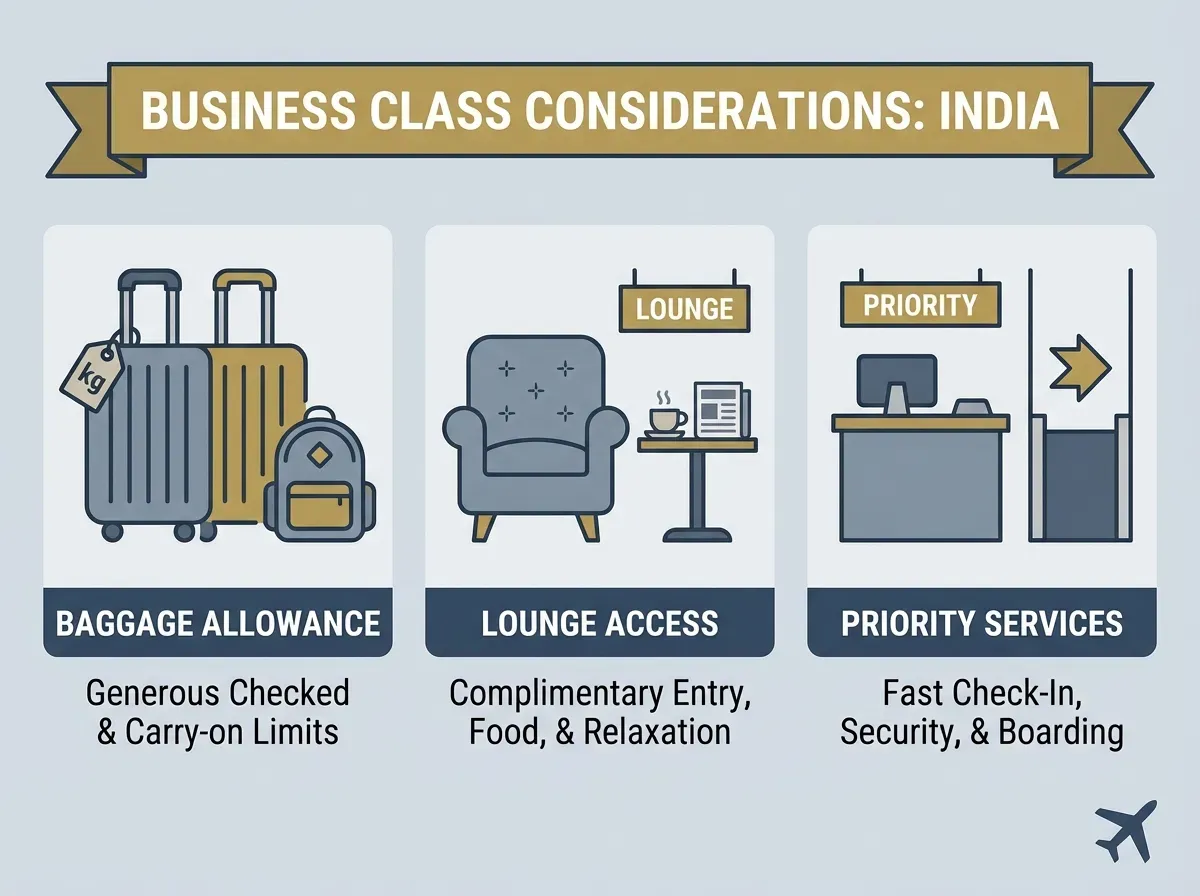
The reality is that business class to India involves more than the seat. Small confirmation steps before you ticket can prevent the most common surprises, especially for family trips and wedding travel where luggage and timing matter.
Baggage allowance: check the operating carrier and the fare brand
Baggage rules are not always identical across airlines, and they can also vary by fare brand within business class. If your itinerary mixes carriers, confirm which airline is operating each segment and which baggage policy applies at check-in. This matters even more when you are carrying extra items for events or traveling with children.
Lounge access: assume nothing on mixed itineraries
Business class generally includes lounge access, but the specific lounge you can use depends on the airline, the cabin, and the airport. Some hubs offer exceptional lounges, others can be crowded at peak departure banks. If lounge quality is part of why you are paying for business class, verify what you will actually have access to during your connection, not just at your departure airport.
Priority services: know what is “included” versus what is airport-dependent
Priority check-in and boarding usually come with business class, but the on-the-ground experience can be very airport dependent. Some airports run dedicated premium security lanes, others do not. If your departure is from a high-congestion airport, arrive with enough buffer that a missing fast lane does not force you into a stressful sprint.
Special meals and seating requests: place them early
If you need a specific meal type or you are traveling with dietary requirements, request it as soon as you ticket. Seat selection also becomes more limited as the flight fills, especially on India peak dates. If you have a must-have seat type, the earlier you lock it in, the fewer compromises you will face.
Miles and Points Considerations (Without Letting Them Drive a Bad Itinerary)
Miles and points can be a meaningful lever on business class tickets to India. The mistake is letting loyalty override the fundamentals of route quality, aircraft, and connection stress.
Use loyalty as a tie-breaker, not the foundation
If two itineraries are close in total travel time and comfort, choose the one that better supports your status, upgrade priority, and mileage earning. If the loyalty-friendly option adds a second connection, a very long layover, or a noticeably weaker seat, the “value” can disappear the moment you arrive exhausted.
Pay attention to mixed-cabin and mixed-carrier segments
Some itineraries price as business class but include a short segment with a different cabin standard, especially on regional legs. Review each segment’s cabin and aircraft. If one leg is not lie-flat, decide whether that tradeoff is acceptable for your schedule.
Keep change flexibility in mind if you are using a complex ticket
Award tickets and partner-issued itineraries can have different change rules and rebooking behavior during disruptions. If your India trip has fixed dates, that may be fine. If your dates may shift, compare the flexibility carefully before you commit.
Booking Timeline and Price Pattern Reality for India Business Class

People often ask when to book business class flights to India. There is no single perfect window, but there are predictable patterns that can help you plan without over-optimizing.
Peak travel periods behave differently
Summer travel, major holidays, and wedding season demand can tighten premium inventory quickly. In those windows, the best schedules and the most desirable seats tend to disappear first. If you have fixed dates in a peak period, booking earlier is often less about “getting a low fare” and more about securing the routing and seat you actually want.
Watch for aircraft and schedule changes
Airlines routinely adjust schedules and swap aircraft seasonally. That is another reason to confirm seat maps and to re-check your itinerary after ticketing. If an aircraft change moves you into a layout you would not have chosen, you may want the option to re-route, which brings you back to fare rules and flexibility.
Use date and airport flexibility in a structured way
If you can move your trip by a day or two, or depart from a nearby US gateway, you can sometimes find noticeably different fare levels on the same airlines. Think of it this way: you are not just changing dates, you are changing which inventory bucket you are likely to access.
Be cautious with “too good to be true” business class pricing
A very low headline fare can be attached to strict change rules, long layovers, or an older seat. Before you buy, validate the total travel time, aircraft type, and fare conditions. A good premium itinerary should feel good on paper before it feels good in the air.
Frequently Asked Questions
What is the typical cost of business class flights to India from the USA?
Pricing moves constantly by season, departure city, and fare rules. As a planning range, Flight-Experts lists Business Class Flight Booking as typically $2,000 to $8,000+ depending on route and airline. Nonstop flights and peak travel windows often price higher, while one stop itineraries can sometimes improve value if your dates and airports are flexible.
Is nonstop always better than one stop for USA to India business class?
Nonstop is usually best for simplicity and total elapsed time, and it reduces missed-connection risk. One stop can be better if it puts you in a newer seat, improves schedules, or saves meaningful money while keeping the trip to a single connection. The “best” choice depends on whether you are optimizing for sleep quality, arrival time, or lowest total travel stress.
Which India destinations are easiest for business class: Delhi or Mumbai?
Delhi and Mumbai are both major international gateways with solid onward connectivity. Delhi can be especially practical for North India and many domestic connections, while Mumbai can be ideal for western India and certain corporate travel patterns. Your best gateway is often the one that aligns your arrival time with your final city’s domestic options and minimizes long waits.
How do I avoid older business class seats on India routes?
Check the aircraft type and the seat map for each segment before booking. Look for modern lie-flat configurations and, when possible, direct aisle access. Keep in mind that aircraft swaps happen, particularly seasonally, so choose fares that you can adjust if the airline changes equipment. A specialist can help filter options to reduce “product roulette.”
Are business class flight deals to India usually refundable or flexible?
Not always. An attractive fare can come with stricter change or cancellation rules depending on fare basis and booking channel. If your dates might move, price the trip in terms of total risk, not just the upfront fare. Many travelers prefer paying slightly more for flexibility, especially for complex family itineraries or business trips.
What is the best business class airline to India?
There is no universal winner because the best option changes by route, aircraft, and what you value. Middle East connections are often strong for overall premium experience, while nonstops can be unbeatable for convenience. If you care most about sleep, choose the best seat and schedule combination, not just the brand name.
Should I book through the airline or through a specialist agency?
Booking direct can be best for loyalty credit, straightforward servicing, and simple itineraries. A specialist agency can be better when you want curated comparisons, help verifying aircraft and fare rules, and access to consolidator pricing that is not always visible publicly. If you want a personalized set of options quickly, Flight-Experts assigns a consultant and presents choices, often within 30 minutes.
Can Flight-Experts help with multi-city India trips (like DEL in, BOM out)?
Yes. If you are planning an open-jaw or multi-city journey, Complex Itinerary Planning is designed for this. Multi-city trips can improve comfort and efficiency by reducing backtracking inside India, but the fare construction matters. A consultant can help you compare total travel time, connection risk, and value across different routing designs.
What are the smartest ways to improve value on business class tickets to India?
Flex your dates by a few days, consider nearby US departure airports, and compare one stop hubs that still keep total travel time reasonable. Verify the aircraft so you do not overpay for an older seat. Pay attention to fare rules, especially if you may need changes. Consolidator pricing can also improve value on some routes and seasons.
Where should I start if I am also considering other Asia destinations?
If India is part of a broader Asia plan, start with the Business Class Flights and Business Class to Asia category pages to understand the core options. From there, narrow by your ideal arrival time, preferred cabin style, and the cities you need in India. A single well-built itinerary can be far better than piecing flights together separately.
How long should my layover be on a one stop business class itinerary to India?
It depends on the hub and your risk tolerance, but you generally want enough time to comfortably reach the lounge, eat, and board without rushing. If you are connecting onward within India on the same day, build a buffer that accounts for real-world delays and the time it can take to change terminals or clear additional screening at the connecting airport.
Do all business class tickets to India include lounge access?
Business class usually includes lounge access, but the exact lounge you can use can depend on the airline, the airport, and whether your itinerary is mixed-carrier. If lounge quality is important to you, confirm access for both your departure airport and your connection hub, not just for the first segment.
Is 1-2-1 always better than 2-2-2 for USA to India business class?
Not always, but it is often better for solo travelers because direct aisle access typically improves sleep and reduces disruption. A 2-2-2 layout can still be comfortable, and it can be a good fit for couples traveling together. The key is to match the layout to how you travel and how much you value privacy.
Should I choose my India gateway based on nonstop availability or domestic connections?
Consider both, but prioritize the total trip. A nonstop into DEL or BOM can be excellent, yet it is not always the best option if it creates a difficult domestic connection, a long wait, or a poor arrival time for your final city. The best gateway is the one that keeps the full itinerary efficient and low-stress.
What should I confirm before booking when I am traveling with extra luggage for a wedding or family trip?
Confirm the baggage allowance for the operating carrier on every segment, and verify that your connection is realistic if you are continuing onward in India. Also confirm seat selection availability early, since popular flights can fill quickly and limit options for couples or families who want specific seat pairings.
Key Takeaways
- For business class flights to India, the best option is usually a tradeoff between nonstop simplicity and one stop comfort or value.
- Verify aircraft and seat layout before booking to avoid paying premium pricing for an older cabin.
- Compare door-to-door travel time, not just flight duration, especially if connecting onward within India.
- Fare rules matter as much as the headline price if there is any chance your plans will change.
- For curated options and potential consolidator pricing, Flight-Experts can present choices quickly with a personal consultant.
Conclusion
Choosing business class flights to India is easiest when you start with the fundamentals: a seat you can sleep in, a schedule that matches your body clock, and a connection strategy that does not add unnecessary friction. Nonstops can be the cleanest solution when available, while one stop routings can deliver a better cabin, better lounge time, or better overall value if built carefully.
If you want a short list of strong options based on your home airport, dates, and target city in India, explore Business Class Flight Booking and request a free quote. You will be matched with a consultant who can compare routings, aircraft, and fare rules, then help you book with confidence.



